
Tag: Christian Living

  • Faithfulness When No One Is Watching: Why Hidden Obedience Still Matters to God

    Faithfulness When No One Is Watching: Why Hidden Obedience Still Matters to God

    Freedom Centre International Church • Christian Living

    Faithfulness When No One Is Watching

    Why hidden obedience still matters to God.

    Faithfulness Integrity Discipleship Christian Character

    Written by Rev Elphas Sipho Mdluli

    Faithfulness when no one is watching reveals whether our obedience depends on recognition or on devotion to God. Much of Christian life happens away from platforms, applause and public attention. God sees the quiet choices, private sacrifices and ordinary acts of obedience that other people may never notice.

    God Sees What Others May Never Notice

    Jesus repeatedly directed attention away from performing righteousness for human approval. In Matthew 6, He spoke about giving, praying and fasting without turning devotion into a public performance. The point was not that every good work must be hidden. The point was that the Father’s approval matters more than being seen by people.

    This truth is deeply freeing. Your obedience does not become meaningless because nobody congratulates you. A prayer offered quietly, a promise kept when breaking it would be easier, an honest decision that costs you something, or a simple act of service can all matter before God.

    1. Hidden Choices Form Visible Character

    Character is built before it is displayed. Public integrity usually rests on many private decisions made over time. If we practise truthfulness only when people are checking, our integrity remains dependent on supervision.

    Christian maturity asks a deeper question: What would I choose if nobody knew except God? That question can expose motives, strengthen conscience and help us bring private conduct under the lordship of Jesus Christ.

    2. Do Small Responsibilities Well

    Some assignments feel too ordinary to be spiritually significant. Yet Scripture consistently honours faithfulness in what has been entrusted to us. Jesus taught that a person who is faithful in little can also be trusted with much.

    Do not despise the ordinary responsibility in front of you. Complete the task carefully. Return what you borrowed. Keep the confidence entrusted to you. Prepare before you serve. Treat another person’s time with respect. These choices may appear small, but they train the heart in stewardship.

    3. Serve Without Needing Recognition

    Recognition can encourage people, and there is nothing wrong with appropriate appreciation. The danger begins when recognition becomes the reason we serve.

    A servant of Christ can contribute faithfully even when another person receives the credit. This does not mean tolerating exploitation or refusing healthy accountability. It means refusing to make applause the measure of whether obedience was worthwhile.

    4. Let Integrity Govern Work and Money

    Hidden faithfulness becomes especially important wherever there is access, authority or limited supervision. Financial records, confidential information, business resources, ministry responsibilities and professional decisions all create opportunities to choose integrity.

    Ask whether your conduct would remain the same if every detail became public. Then go further: remember that Christian integrity is not ultimately maintained by the possibility of exposure. It is maintained by reverence for God and love for what is right.

    5. Be Faithful in Relationships Behind Closed Doors

    Public kindness cannot compensate for private harshness. Christian character should be visible in the home as well as in church, business or ministry.

    Speak respectfully to the people closest to you. Admit when you are wrong. Keep appropriate boundaries. Refuse manipulation. Practise forgiveness without pretending that harmful conduct is acceptable. Hidden relational faithfulness is part of discipleship.

    6. Do Not Confuse Hiddenness With Insignificance

    Some seasons of life feel unseen. You may be serving, learning, caring, rebuilding or preparing without much public evidence of progress. Hiddenness can tempt us to believe that nothing important is happening.

    But roots grow before fruit becomes visible. Preparation often precedes opportunity. Character can deepen before responsibility expands. Instead of measuring every season by visibility, ask what God may be forming in you through faithful obedience.

    7. Check Your Motive Before God

    It is possible to do a right thing for a confused reason. We may serve because we want approval, give because we want influence, or speak because we want to appear spiritual.

    Bring motives honestly before God. Ask Him to purify your desire for recognition and teach you to value His pleasure above human applause. This is not a one-time achievement. It is part of ongoing spiritual formation.

    A Simple Hidden-Faithfulness Check

    MOTIVE
    INTEGRITY
    STEWARDSHIP
    SERVICE
    CONSISTENCY

    MOTIVE — Am I doing this to honour God or mainly to be noticed? INTEGRITY — Would I make the same choice without supervision? STEWARDSHIP — Am I handling what has been entrusted to me responsibly? SERVICE — Can I contribute without demanding credit? CONSISTENCY — Does my private conduct agree with my public profession?

    When Faithfulness Feels Unrewarded

    There will be times when doing the right thing seems to produce no immediate reward. Someone else may be praised. Your sacrifice may be overlooked. Your integrity may even cost you an opportunity.

    Do not build a theology that promises immediate earthly reward for every act of obedience. Instead, anchor yourself in the character of God. He is worthy of obedience even when outcomes are delayed, misunderstood or unseen. Christian faithfulness is ultimately a response to who God is.

    Final Reflection

    Faithfulness does not begin when people notice you. It begins when Christ is enough reason to obey. Let your hidden choices support your public confession. Serve well, handle responsibility carefully, practise integrity and remain faithful in ordinary places.

    People may not see every act of obedience, but your life is still being formed by what you repeatedly choose. Seek the Father’s approval, and let faithfulness become part of who you are.

    Personal Prayer

    Father, teach me to be faithful whether I am seen or unseen. Purify my motives and help my private choices agree with the faith I profess. Give me integrity in my work, relationships, stewardship and service. Keep me from living for applause, and help me honour Jesus Christ in the ordinary responsibilities You have entrusted to me. Amen.
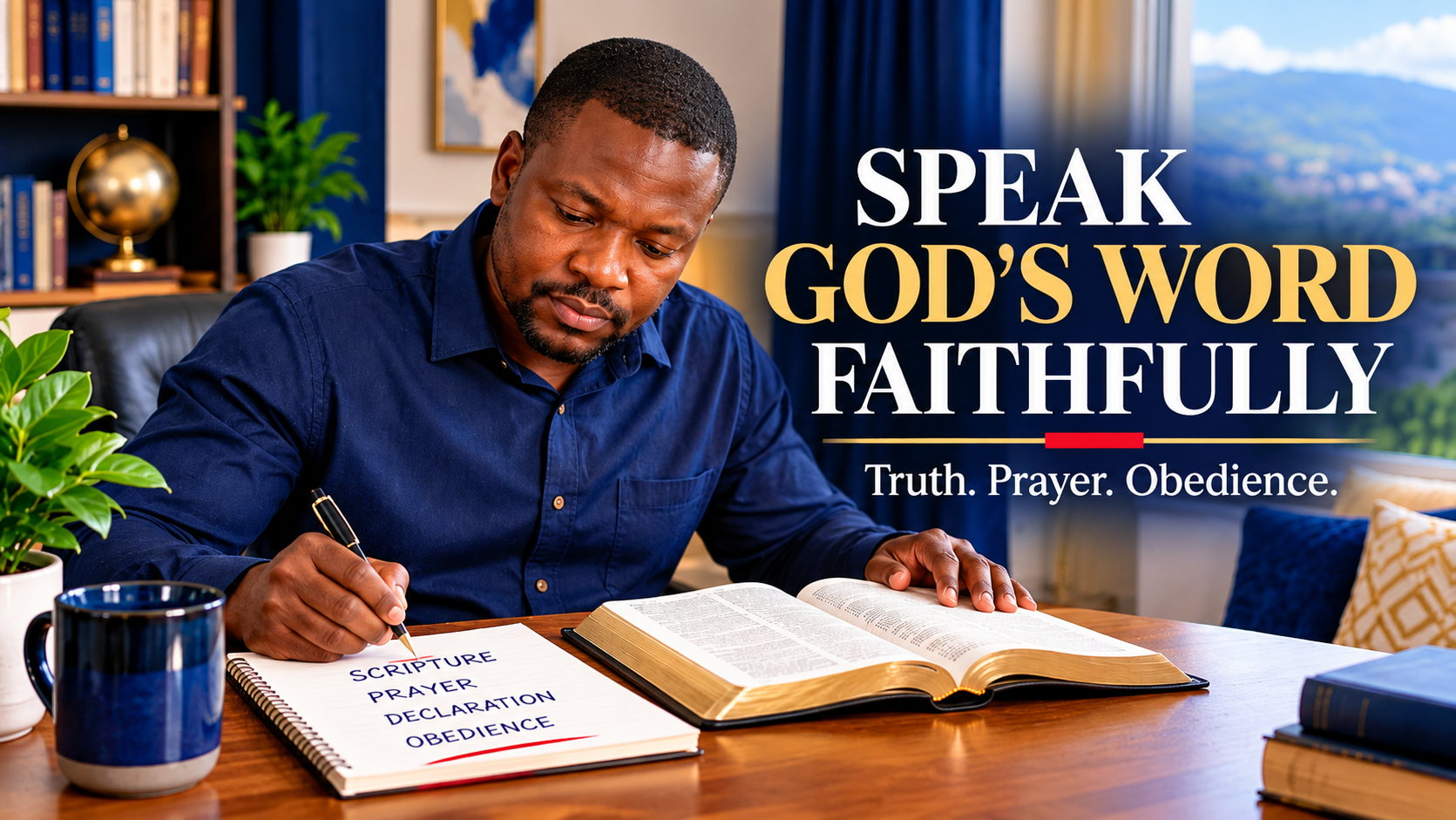

  • How to Speak God’s Word Without Turning Faith Into a Formula

    How to Speak God’s Word Without Turning Faith Into a Formula

    Freedom Centre International Church

    How to Speak God’s Word Without Turning Faith Into a Formula

    Learn how biblical truth can shape your speech, prayers, decisions and daily responses without reducing Christian faith to a verbal formula.

    Scripture Prayer Biblical Declarations Obedience
    Written by Rev Elphas Sipho Mdluli

    Speak God’s Word faithfully by allowing Scripture to shape what you believe, pray, declare and do. Biblical faith is not a formula for controlling circumstances. It is a Christ-centred response to God’s truth that brings together Scripture, prayer, trust, surrender and practical obedience.

    Our words matter, but Christian faith involves far more than positive speech. What we say must remain rooted in biblical truth, centred on Jesus Christ and connected to obedient living.

    There is an important difference between biblical faith and treating words as a spiritual formula. Scripture does not teach us to use words as a mechanism for forcing God to produce whatever outcome we desire.

    Biblical declarations are not magic words that force God to give us whatever we want. Neither are they a method of pretending that pain, sickness, financial difficulty, disappointment or other challenges do not exist.

    Rather, speaking God’s Word means bringing our thinking, speech, prayers and responses under the authority of Scripture.

    “Sanctify them by Your truth. Your word is truth.”

    John 17:17 (NKJV)
    1

    Speak God’s Word Faithfully by Starting With Scripture

    If we want to speak God’s Word faithfully, Scripture must come before our declarations.

    It can be tempting to begin with what we want and then search for a Bible verse that appears to support it. A healthier approach is to begin with Scripture itself.

    Ask first: What does this passage actually teach?

    Read the surrounding verses. Consider who was speaking, who was being addressed and what the passage means within the wider teaching of Scripture.

    “Be diligent to present yourself approved to God, a worker who does not need to be ashamed, rightly dividing the word of truth.”

    2 Timothy 2:15 (NKJV)

    Before turning a verse into a declaration, seek to understand it correctly. This protects us from using Scripture merely to confirm our own desires.

    2

    Keep Jesus Christ at the Centre

    Biblical faith is ultimately not faith in our ability to speak correctly. It is faith in God.

    The power of Christianity does not come from discovering the perfect combination of words. Our confidence rests in Jesus Christ—His finished work, His character, His promises and His lordship.

    “For all the promises of God in Him are Yes, and in Him Amen, to the glory of God through us.”

    2 Corinthians 1:20 (NKJV)

    Christ should therefore remain at the centre of what we believe and confess. Our words should direct our hearts towards Him rather than merely towards the outcomes we desire.

    3

    Faith Does Not Require You to Deny Reality

    Faith does not require us to pretend. A Christian facing difficulty can acknowledge the reality of the situation while still trusting God.

    David repeatedly demonstrated this in the Psalms. He spoke openly about fear, opposition, discouragement and danger. Yet he continually returned his attention to the character and faithfulness of God.

    “This situation is difficult, but God is with me.”

    You may also acknowledge: “I do not yet know how this problem will be resolved, but I will seek God for wisdom and continue doing what is right.”

    Speaking biblical truth allows God’s truth to become greater than fear without requiring us to deny reality.

    4

    Turn Scripture Into Prayer

    One of the safest ways to develop biblical declarations is to begin with prayer.

    Suppose you are struggling with anxiety. Instead of immediately making exaggerated statements about what will happen, begin with Philippians 4:6–7 and bring the matter before God.

    Father, help me bring my concerns to You in prayer. Guard my heart and mind through Christ Jesus.

    From that prayer, a responsible declaration can emerge:

    I will bring my anxieties to God in prayer and trust Him to guard my heart and mind.

    The declaration remains close to Scripture. It does not attempt to control God. It expresses faith while maintaining humility.

    5

    Connect Your Words With Obedience

    Biblical declarations should influence behaviour. What we confess from Scripture should increasingly become visible in how we live.

    “But be doers of the word, and not hearers only, deceiving yourselves.”

    James 1:22 (NKJV)

    If you declare that God calls you to forgive, begin taking steps towards forgiveness.

    If you declare that God has called you to stewardship, manage what He has entrusted to you responsibly.

    If you declare that God gives wisdom, seek wisdom before making important decisions.

    The strongest declaration is often the one that becomes visible through obedient living.
    6

    Avoid Turning Faith Into a Formula

    There is a danger in believing that if we repeat certain words enough times, God must produce the outcome we want.

    That is not biblical faith. God remains sovereign. Prayer is relational, not mechanical.

    “Nevertheless not My will, but Yours, be done.”

    Luke 22:42 (NKJV)

    This is not weak faith. It is surrendered faith.

    We can pray boldly. We can believe God’s promises. We can speak Scripture confidently. Yet our confidence must always remain under God’s authority.

    7

    Let God’s Word Renew Your Thinking

    Speaking Scripture is especially valuable when it becomes part of the renewal of the mind.

    “And do not be conformed to this world, but be transformed by the renewing of your mind…”

    Romans 12:2 (NKJV)

    Instead of allowing fear, disappointment or past experiences to become the final authority, we allow God’s truth to reshape our thinking.

    This is where biblical declarations can become a valuable spiritual discipline. They help us deliberately return our minds to truth.

    8

    Make Your Declarations Christ-Centred and Responsible

    A healthy biblical declaration should be something you can genuinely say before God with humility.

    Biblical Declarations for Faithful Christian Living

    God is with me, so I will not allow fear to control my decisions.
    Through Christ, I will pursue forgiveness rather than bitterness.
    I will ask God for wisdom and act responsibly with what He places in my hands.
    My circumstances do not determine God’s character.
    I will continue praying, obeying and trusting God even while I wait.

    These declarations do not attempt to manipulate circumstances. They position the believer to respond to circumstances through faith.

    A Simple Pattern to Speak God’s Word Faithfully

    Use this five-step framework to keep biblical declarations rooted in Scripture, prayer and practical discipleship.

    SCRIPTURE What does God’s Word actually say?
    TRUTH What biblical truth should shape my thinking?
    PRAYER How should I bring this matter before God?
    DECLARATION What can I faithfully say in agreement with Scripture?
    OBEDIENCE What faithful action should now follow?

    Speak Life While Remaining Rooted in Truth

    There is great value in learning to discipline our speech. We do not need to allow fear, bitterness, hopelessness or uncontrolled emotion to determine everything we say.

    Speak God’s promises. Declare biblical truth. Pray confidently. Reject destructive thinking. Encourage yourself in the Lord.

    But also remain humble, obedient and surrendered to God’s will.

    When we speak God’s Word faithfully, our goal is not simply to say better words. We allow biblical truth to shape our thinking, speech, decisions and actions so that our lives increasingly reflect Jesus Christ.

    The goal is not simply to say better words. The goal is to become a person whose thinking, speech and actions increasingly reflect Jesus Christ.

    Continue Growing Through Biblical Teaching

    Freedom Centre International Church exists to help people encounter biblical truth, grow in Christ and live out their faith practically. Continue exploring our church resources and ministry.

    Recommended Christian Resource

    Continue Applying God’s Word

    For readers who would like a structured resource for developing Scripture-centred declarations and intentional spiritual growth.

    Speak Life: 90 Powerful Biblical Declarations for Wholeness and Breakthrough

    Author: Elphas Sipho Mdluli

    A Christian resource designed to help readers engage biblical truth through Scripture-centred declarations and intentional spiritual growth.

    View the Book on Amazon

    Closing Prayer

    Father, thank You for giving us Your Word as truth. Teach us to understand Scripture correctly and to allow it to renew our minds. Guard us from using Your Word carelessly or turning faith into a formula. Help us speak with faith, humility and wisdom. May our prayers, declarations, decisions and actions honour Jesus Christ. Give us grace not only to hear Your Word but also to obey it. In Jesus’ name, Amen.

    Freedom Centre International Church
    “Set Free by the Word”
    Biblical Truth • Christ-Centred Living • Practical Discipleship
  • Stretching Beyond Comfort: How Faith and Obedience Lead to Divine Expansion

    Stretching Beyond Comfort: How Faith and Obedience Lead to Divine Expansion

    Stretching Beyond Comfort: How Faith and Obedience Lead to Divine Expansion

    God never intended His people to remain confined by fear, routine, or comfort. Through faith in Christ, believers are called to stretch beyond familiar boundaries and step into divine expansion.

    Many believers are sincere in faith yet quietly sense that their spiritual lives have become smaller than God’s call upon them. They love Christ, believe the Scriptures, attend worship, pray at certain times, and desire to live faithfully. Yet inwardly, they know there are areas where comfort has become stronger than obedience, routine has replaced growth, and familiarity has quietly resisted faith.

    This is one of the great spiritual tensions of Christian maturity: God calls His people into enlargement, yet the human heart often seeks safety. We want divine increase, but we do not always welcome divine stretching. We desire spiritual growth in Christ, but growth usually requires the surrender of old patterns, limited thinking, and emotional dependence on what feels manageable.

    Stretching Beyond Comfort is not merely about attempting bigger things. It is about allowing Christ to form a deeper, stronger, more obedient life within us. True expansion through faith begins when believers stop treating comfort as a sign of safety and begin seeing obedience as the pathway of maturity.

    When Discomfort Becomes an Invitation

    The discomfort of growth does not always mean something is wrong. Often, it means God is inviting us into maturity.

    A believer may feel unsettled when God begins calling them to pray more consistently, forgive more deeply, serve more faithfully, give more sacrificially, or step into a responsibility they feel unqualified to carry. That discomfort is not necessarily failure. It may be the evidence that God is stretching the inner life so that the outer life can carry greater fruit.

    “But without faith it is impossible to please Him…” — Hebrews 11:6

    Faith is not passive agreement with truth. Faith is active trust in God’s character. It believes that God is real, faithful, present, and worthy of obedience even when the way forward feels unfamiliar.

    “Enlarge the place of your tent… lengthen your cords, and strengthen your stakes.” — Isaiah 54:2

    The command is both expansive and structural. God does not only say, “Make room.” He also says, “Strengthen what will hold the increase.” This is essential for Christian faith and growth. Godly expansion is not emotional excitement; it requires formation, alignment, discipline, stewardship, and obedience.

    This is why every believer who desires maturity needs more than inspiration. We need structure, community, doctrine, and discipleship. Those who desire guided spiritual growth can begin walking through our structured discipleship pathway, where faith is not only taught but practiced within a community of believers.

    Biblical Foundation for Stretching Beyond Comfort

    The central biblical truth is clear: God often calls His people beyond the boundaries of comfort so they may grow into deeper dependence on Him.

    Isaiah 54:2 teaches that enlargement requires preparation. Israel is told to enlarge the tent before visible increase has fully appeared. This reveals an important principle: faith prepares for what obedience has not yet seen. Trusting God for expansion requires believers to act on His Word before circumstances confirm the outcome.

    Luke 5:4–6 gives another powerful picture. Jesus tells Peter, “Launch out into the deep and let down your nets for a catch.” Peter had already laboured through the night and caught nothing. Yet when he obeyed Christ, the catch was so great that the nets began to break. The miracle was not found near the shore of familiarity; it was found in deeper obedience.

    Romans 12:2 teaches believers not to be conformed to this world but transformed by the renewing of the mind. John 15:5 reminds us that apart from Christ, we can do nothing. Philippians 2:13 adds that God works in His people both to will and to do for His good pleasure.

    A Formation Framework for Divine Expansion

    1. Establish Foundations Before Increase

    Divine increase through faith must rest on solid foundations. A tent can be enlarged only if its stakes are strengthened. A life can carry greater responsibility only when its foundation is ordered.

    Many believers want visible growth without hidden formation. They desire influence without discipline, opportunity without preparation, and expansion without structure. Yet God’s pattern is different. Before He increases capacity, He often strengthens character.

    For believers, foundations include doctrine, prayer, obedience, Scripture, community, character, and spiritual accountability. Those who are beginning or rebuilding their walk with Christ should begin with our Foundations Class.

    2. Receive Stretching as Part of Spiritual Formation

    Stretching is uncomfortable because it exposes dependence. It reveals where fear still governs, where pride still resists surrender, and where comfort has become an idol.

    In Luke 5, Peter’s stretching came at the point of disappointment. He had already failed in the area where he was skilled. Yet Jesus met him there and called him deeper.

    Stretching Beyond Comfort begins when we stop negotiating with obedience and start trusting the One who calls.

    3. Build Spiritual Rhythm Instead of Depending on Emotion

    Spiritual maturity is formed through rhythm, not occasional emotion. An ordered spiritual life is not legalism. It is stewardship. Discipline does not replace grace; it creates space for grace to shape the believer more deeply.

    Alignment places Christ at the center. Discipline gives structure to devotion. Stewardship treats time, gifts, relationships, and opportunities as entrusted by God. Influence becomes the fruit of a life formed under Christ’s lordship.

    For regular encouragement and formation insights, follow the WhatsApp Channel for regular insights.

    4. Allow Community to Shape Maturity

    Spiritual growth is personal, but it is not private. The church is where biblical principles are practiced, embodied, corrected, and lived within community.

    Church is not merely a place to visit; it is a spiritual family where believers learn to walk together under Christ. If you desire to grow within such belonging, you can connect with our church community.

    Sound doctrine also protects growth. Faith must be rooted in truth, not personal preference. For biblical beliefs and doctrine, you may read more about what we believe.

    5. Turn Obedience Into Life Structure

    Comfort zones limit divine increase because they create invisible boundaries around obedience. They make the believer settle for survival when God is calling them into fruitfulness.

    A believer who only obeys when it is easy will remain spiritually unstable. But when obedience becomes a settled pattern, the life begins to take shape around God’s will.

    Where pastoral care or spiritual guidance is needed, believers should not walk alone. You may reach out for pastoral care and guidance.

    Practical Formation Guidance

    To move from information to transformation, believers must practice what they have received.

    • Where have I become too comfortable spiritually?
    • What has God been asking me to enlarge?
    • What fear is keeping me near the shore?
    • What obedience have I delayed?
    • What structure must be strengthened before increase can be sustained?

    Set a consistent time for prayer. Read Scripture with the intention to obey. Participate in church community. Submit your growth to wise counsel. Serve faithfully. Practice generosity. Review your life regularly before God.

    Ecosystem Pathway for Continued Growth

    Intellectual Growth: Freedom Hub

    Those desiring deeper biblical understanding may continue exploring structured teachings through Freedom Hub. This is especially helpful for believers who want to connect faith with practical areas such as finances, marriage, coaching, leadership, and personal growth.

    Spiritual Formation: Church

    Spiritual formation is lived in the body of Christ. Believers who desire structured spiritual growth can continue through our structured discipleship pathway, connect with our church community, and begin with our Foundations Class where necessary.

    Guided Depth: Purpose, Stewardship & Growth

    Some believers desire a deeper guided environment for intentional growth, reflection, and life stewardship. The Purpose, Stewardship & Growth community offers a structured space for believers who want to grow with greater focus and consistency.

    Key Takeaways

    • Expansion requires stretching.
    • Faith prepares before manifestation.
    • Comfort zones can limit God’s increase.
    • Christ empowers believers to obey beyond fear.
    • Miracles often occur in deeper levels of obedience.
    • Spiritual growth requires dependence on Christ.
    • Divine increase follows faithful obedience.

    Conclusion: The Miracle Is in the Deep

    Stretching Beyond Comfort is not a call to restless ambition. It is a call to faithful obedience. God is not merely trying to make life bigger; He is forming believers who can carry growth with humility, wisdom, and spiritual strength.

    The shore may feel safe, but the miracle is often in the deep. The believer today is invited into the same pattern of faith: trust God, strengthen the stakes, lengthen the cords, and obey Christ beyond the boundaries of comfort.

    Christ is the foundation of our obedience, the example we follow, and the power that enables transformation. He does not call His people deeper and then abandon them. He walks with them, strengthens them, corrects them, and forms them.

    You do not drift into spiritual maturity — you grow into it through intentional discipleship.