Tag: discipleship

  • Growing Deep Before Growing Wide: A Devotional on God’s Work Before Increase

    Growing Deep Before Growing Wide: A Devotional on God’s Work Before Increase

    Christian Devotional

    Growing Deep Before Growing Wide

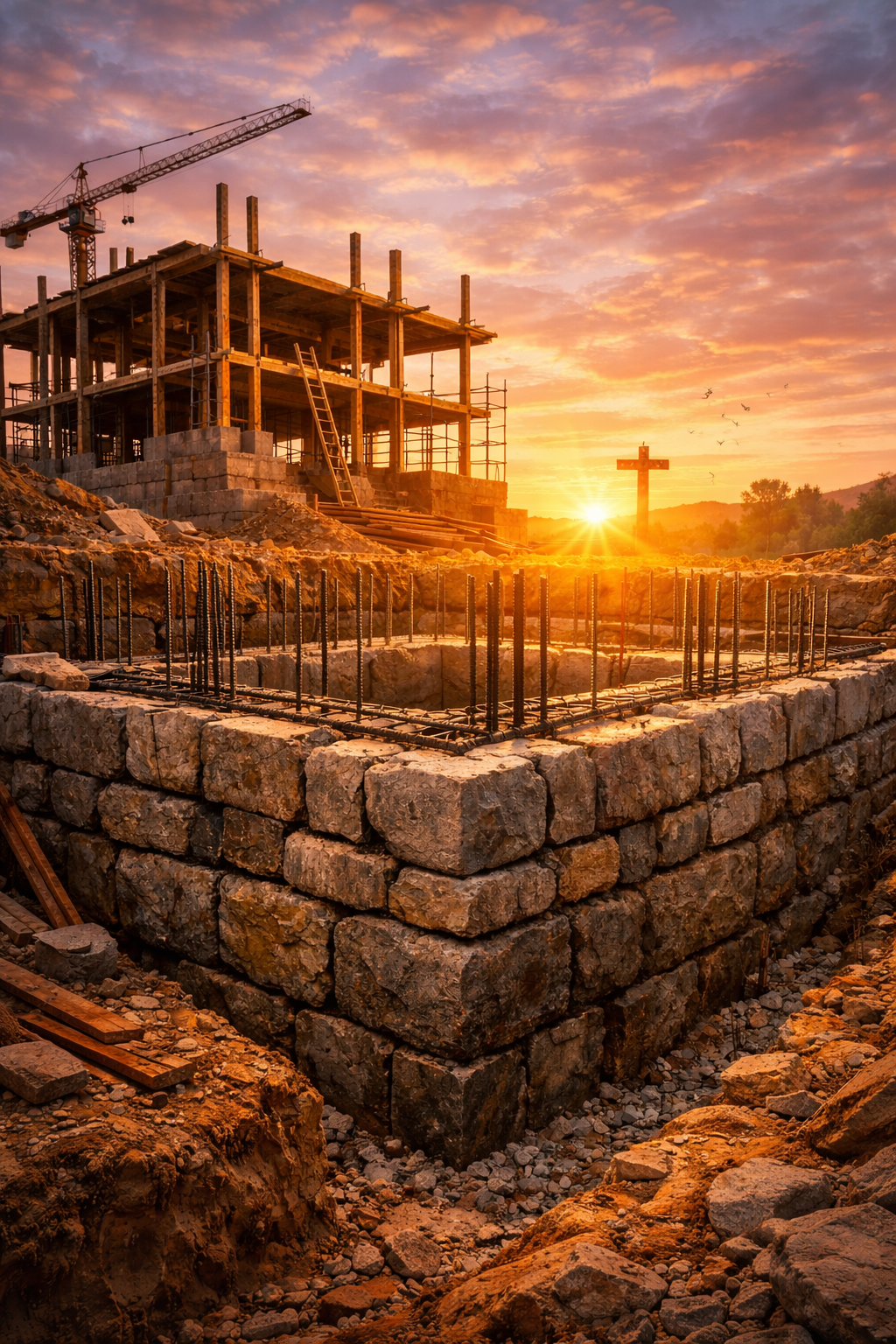
    God often works beneath the surface before He releases visible increase. He forms character, strengthens faithfulness, and establishes foundations so believers can carry greater responsibility with maturity and stability.

    Key Scripture

    Luke 16:10

    “He who is faithful in what is least is faithful also in much; and he who is unjust in what is least is unjust also in much.”

    Devotional Reflection

    Many believers desire increase in their spiritual lives. They long for greater fruit, deeper purpose, stronger influence, and clearer direction in the things God has called them to do. Yet there are seasons when visible progress appears slow, and it may feel as though growth has paused.

    In reality, God is often doing His most important work beneath the surface. Scripture repeatedly shows that the Lord establishes foundations before He releases expansion. He forms character before enlarging responsibility. He develops faithfulness before entrusting influence. What appears to be delay is often preparation.

    Joseph learned integrity in slavery and faithfulness in prison before he governed Egypt. David served as a shepherd and later endured life as a fugitive before he sat on Israel’s throne. Even Jesus lived many years in hidden preparation before beginning His public ministry.

    God’s pattern has not changed. He is not only interested in what believers accomplish, but also in who they become. Influence without formation becomes unstable. Responsibility without maturity becomes dangerous. But when character is formed deeply, increase can be sustained faithfully.

    If God is strengthening your inner life, shaping your motives, teaching consistency, or developing quiet obedience, He is not ignoring your calling. He is preparing you to carry it well. What God builds deeply, He sustains greatly.

    Lessons from This Devotional

    1. God Strengthens Character Before He Expands Influence

      The Kingdom of God values depth over speed. The Lord often works in hidden places, shaping humility, faithfulness, discipline, and obedience before allowing visible growth. This preparation protects believers from the dangers of premature influence.

      For deeper biblical teaching on this principle, read the full teaching on foundations before increase .

    2. Faithfulness in Small Things Reveals Spiritual Readiness

      Jesus taught that faithfulness in small responsibilities reveals readiness for greater ones. Many believers look for larger opportunities while overlooking the spiritual significance of daily obedience.

      Prayer, integrity, service, forgiveness, and discipline may seem small, but they form the spiritual structure of a mature life. Growth in Christ rarely happens through sudden leaps. It develops through steady faithfulness.

    3. Spiritual Growth Happens Within Discipleship

      Christian maturity is not built in isolation. Believers grow through teaching, correction, community, and shared life within the church. The New Testament consistently shows that discipleship happens through spiritual community where believers practice truth together.

      If you desire structured spiritual growth, explore the church discipleship journey , begin with the Foundations Class , connect through the church community page , or reach out for pastoral support and guidance .

    Prayer

    Heavenly Father, thank You for caring not only about what I accomplish, but about who I become. Teach me to embrace the seasons where You are strengthening my foundations. Help me to be faithful in hidden places, obedient in small things, and patient while You prepare me for what lies ahead.

    Form my character so that my life reflects Christ. Align my heart with Your purposes and help me grow steadily in maturity. In Jesus’ name, Amen.

    Declarations

    • God is building strong spiritual foundations in my life.
    • I am faithful in small things, and God is preparing me for greater responsibility.
    • My character is being shaped through obedience and discipline.
    • I grow steadily in Christ as I walk in discipleship and community.

    Continue Growing Intentionally

    Final Reflection

    God’s way is not rushed. He builds slowly, carefully, and intentionally. Before He expands influence, He establishes character. Before He increases responsibility, He strengthens faithfulness.

    Spiritual maturity is not accidental. You do not drift into it. You grow into it through intentional discipleship, steady obedience, and a life that allows God to form deep foundations before visible increase.

  • Foundations Before Increase: Why God Builds Character Before Calling

    Foundations Before Increase: Why God Builds Character Before Calling

    Discipleship & Spiritual Growth

    Foundations Before Increase: Why God Builds Character Before Calling

    God often strengthens the hidden structure of a believer’s life before releasing visible increase. What He builds deeply, He sustains greatly.

    Introduction: The Tension Between Desire and Readiness

    Many believers are sincere in faith yet quietly sense that their spiritual lives lack structure, depth, and intentional growth. They love God, attend services, pray when they can, and desire to be useful in His Kingdom, yet beneath that desire lies an inner tension: the longing for increase without the weight-bearing formation required to sustain it. Many want clarity, influence, fruitfulness, and calling, but do not always understand why God often delays visible expansion while He strengthens what cannot yet be seen.

    This is not always a sign of spiritual failure. Often, it is an invitation into maturity.

    God is not careless with increase. He does not merely respond to human ambition, visible gifting, or sincere desire. He builds deeply before He builds broadly. He forms character before enlarging responsibility. He strengthens inner life before entrusting outer influence. In the wisdom of God, foundations before increase is not a delay tactic; it is an act of mercy.

    A life that rises too quickly without inward formation becomes vulnerable to collapse under the weight of its own visibility. Yet a life patiently shaped by truth, obedience, humility, and discipline develops the strength to carry what God intends for the long term. This is why spiritual growth must never be reduced to excitement, information, or outward activity. True discipleship is the formation of the whole person under the Lordship of Christ, within the life of the church, through truth practiced consistently in community.

    Those seeking a steady path of growth may begin exploring our structured discipleship pathway, where spiritual development is treated as intentional, pastoral, and rooted in Scripture.

    Biblical Foundation: God Establishes Before He Enlarges

    The pattern is deeply biblical. Scripture repeatedly reveals that God values inward establishment before outward assignment.

    Anchor Scripture: Luke 16:10

    Jesus says, “He who is faithful in what is least is faithful also in much; and he who is unjust in what is least is unjust also in much.” This is not merely about money or task management. It reveals a Kingdom principle: small things expose deeper realities. Faithfulness in hidden places reveals whether the inner structure of a person can sustain greater trust.

    Supporting Scripture: Psalm 92:12–13

    The righteous flourish because they are planted in the house of the Lord. Flourishing is not random. It grows from rootedness. Before there is fruit, there must be planting. Before there is expansion, there must be placement.

    Supporting Scripture: 1 Timothy 3:6

    Paul warns that a spiritual leader must not be a novice, lest pride destroy him. The issue is not talent but maturity. A gifted person may appear ready outwardly while still lacking the inward steadiness necessary for responsible leadership. God cares not only that people serve, but that they serve with formed character.

    Supporting Scripture: Matthew 7:24–25

    Jesus compares obedience to building a house on rock. The storm does not determine whether the structure is valuable; it reveals whether the foundation is sound. Much of Christian maturity is tested not in public success but in private endurance.

    Supporting Scripture: Galatians 5:22–23

    The fruit of the Spirit is not platform, speed, or visibility, but love, joy, peace, patience, kindness, goodness, faithfulness, gentleness, and self-control. The Spirit first forms the inner life. Only then can the outward life remain stable.

    Taken together, these passages teach an important theological truth: God’s priority is not merely to use people, but to conform them to Christ. Calling without character is dangerous. Increase without depth is unstable. Influence without formation is difficult to steward faithfully. God’s building process is therefore not merely functional; it is transformational.

    Why Foundations Matter in the Life of a Believer

    Many believers confuse spiritual movement with spiritual maturity. Activity can increase while formation remains shallow. A person can become busier in church life, more vocal in Christian language, or more visible in ministry without becoming more rooted in truth, disciplined in obedience, or stable in character.

    This is why the church must be understood not merely as a gathering place, but as the environment in which biblical truth is practiced, embodied, and lived. Maturity does not happen in isolation. Believers grow through worship, instruction, correction, service, accountability, and shared life. Growth becomes sustainable when faith moves from private sincerity into ordered discipleship.

    Those seeking structured spiritual growth can begin to understand this journey through our structured discipleship pathway, where growth is not treated as accidental, but intentional and formative.

    A Formation Framework: How God Builds Before He Increases

    1. Foundations Before Increase

    The first movement is the central one: God establishes foundations before He releases increase.

    This means He addresses inner instability before enlarging outward responsibility. He works on motives before assignment, humility before visibility, and obedience before influence. This is why some seasons feel slow. God may not be withholding progress; He may be laying structure.

    Biblically, Joseph’s life reflects this pattern. Before he stood in public leadership, he was formed through hidden obedience, suffering, restraint, and faithfulness in places where promotion was not yet visible. David was anointed before he was enthroned, but much of his formation took place in obscurity. Even Jesus lived thirty years before entering three years of public ministry. God is never in a hurry to build what has not yet been deeply established.

    Leadership insight here is crucial: people often pray for greater reach when God is first building greater capacity. The wise believer stops measuring only visible outcomes and begins asking deeper questions. Am I becoming trustworthy? Am I teachable? Am I faithful when no one notices? Can my character carry what my prayers are requesting?

    Life application requires humility. If God is strengthening your foundation, do not despise that season. Hidden obedience is not wasted time. Private integrity is not a lesser form of ministry. Depth is preparation.

    2. Identity Formation Before Function

    The second movement is identity formation. God wants believers rooted in who they are in Christ before they define themselves by what they do for Him.

    Many spiritual struggles come from trying to perform calling without resting in identity. When identity is weak, believers begin to seek affirmation from titles, opportunities, recognition, or comparison. But when identity is anchored in Christ, service becomes stewardship rather than self-construction.

    Scripture teaches this clearly in Ephesians 2:10: believers are God’s workmanship, created in Christ Jesus for good works. The order matters. We are first His workmanship, then His workers. Formation precedes function.

    This is essential for discipleship growth. A believer who knows they belong to Christ can endure correction, wait through quiet seasons, serve faithfully in ordinary places, and resist the emotional instability that comes from seeking constant validation. Identity produces steadiness.

    Leadership also requires this. Leaders who do not know who they are often become reactive, insecure, and approval-driven. But leaders formed in Christ can serve with conviction, patience, and peace.

    This identity is strengthened in biblical community. Believers are not meant to drift alone. If you are seeking belonging and growth within a spiritual family, you may connect with our church community, where faith is lived in relationship rather than isolation.

    3. Obedience as Spiritual Structure

    The third movement is obedience as structure.

    Modern believers often speak of passion, vision, and spiritual hunger, yet overlook the quiet strength of obedience. Scripture does not present obedience as lifeless duty but as the architecture of a stable spiritual life. Jesus says in John 14:21 that the one who has His commandments and keeps them is the one who loves Him. Love is not merely emotional affection; it is revealed through responsive loyalty.

    Obedience creates form in a believer’s life. It orders priorities. It trains desires. It brings alignment between confession and conduct. It protects a person from building spirituality on mood alone.

    This is where many sincere believers need renewal. They know truth, but do not yet have rhythm. They desire growth, but lack structure. They feel called, but are not consistently ordered. Yet lasting maturity is built through repeated obedience in ordinary days: prayer even when emotion is low, service even when unseen, forgiveness even when costly, honesty even when inconvenient, and submission to Scripture even when culture resists it.

    Theologically, obedience is not an attempt to earn God’s love. It is the fruit of grace at work in the life of a disciple. Grace does not remove the need for structure; it empowers it.

    For those who need a clear place to begin, a strong next step is to begin with our Foundations Class, where core Christian growth is given shape through biblical grounding.

    4. Growth Through Discipleship, Not Isolation

    The fourth movement is growth through discipleship rather than isolation.

    Believers do not mature merely by consuming content. They grow through accountable, embodied, relational discipleship. This is why the New Testament consistently presents the Christian life within the life of the church. The church is not an optional addition to personal faith. It is the God-ordained environment where doctrine becomes practice, love becomes visible, and formation becomes communal.

    In Hebrews 10:24–25, believers are instructed not to neglect gathering together, but to encourage one another. In Ephesians 4:11–16, the church grows into maturity as each part does its work under Christ. This is not passive attendance but living participation.

    Discipleship is where blind spots are exposed, virtues are strengthened, and responsibility is shared. It teaches believers how to receive correction without offense, how to serve without applause, and how to remain steady over time. That kind of formation cannot be built by preference-driven spirituality alone.

    Biblical maturity also requires theological clarity. If believers are to be stable, they must know what they believe and why. Our understanding of doctrine shapes our lives. Those wanting to ground themselves in biblical truth may explore our biblical beliefs, where doctrine is treated as foundational to faithful living.

    5. Stewarded Influence Rather Than Premature Visibility

    The fifth movement is stewarded influence.

    Increase in Scripture is never merely about expansion. It is about responsibility. Influence is not given so believers can be seen; it is given so Christ can be represented faithfully. This is where the Ordered Life philosophy becomes especially helpful: spiritual alignment, disciplined structure, faithful stewardship, and purposeful influence belong together.

    A disordered inner life cannot sustain Kingdom influence for long. But when a believer is aligned with God, disciplined in practice, faithful in stewardship, and mature in motive, influence becomes weight-bearing rather than self-promoting.

    This is true in ministry, family life, work, leadership, and service. The question is not simply, “How can I increase?” but “How can I become the kind of person who can steward increase well?” That is a more biblical question. It shifts attention from speed to substance.

    “What God builds deeply, He sustains greatly.”

    Ordered Life Integration: Alignment Before Expansion

    The principle of foundations before increase connects deeply with spiritual alignment and disciplined structure.

    Alignment means the heart, mind, habits, and direction of life are being brought under Christ. Discipline means that growth is supported by repeated, faithful practice. Without alignment, increase becomes distorted. Without discipline, intentions remain weak. God therefore forms believers inwardly so that their outward lives are built on order rather than impulse.

    This has practical implications. A believer cannot expect stable increase while neglecting prayer, Scripture, fellowship, repentance, stewardship, and service. These are not minor habits. They are spiritual beams within the life God is building.

    Growth becomes healthy when believers stop chasing only moments of inspiration and begin embracing rhythms of formation.

    Practical Formation Guidance

    To move from information to transformation, believers need more than understanding. They need practices that support formation.

    Reflection Questions

    • In what area of life am I desiring increase more than I am embracing formation?
    • Where might God be strengthening my foundation rather than denying my progress?
    • Is my identity rooted in Christ, or am I measuring myself by visibility and recognition?
    • What habits currently support spiritual structure in my life?
    • Who knows me well enough to help me grow in accountable discipleship?

    Spiritual Practices

    • Establish a consistent rhythm of Scripture reading, prayer, and reflection.
    • Practice hidden obedience by serving faithfully where recognition is minimal.
    • Submit regularly to biblical teaching within the church.
    • Make repentance a steady discipline, not merely an emergency response.
    • Cultivate silence before God so that ambition is purified and motives become clearer.

    Leadership Applications

    • Examine whether public responsibility is supported by private integrity.
    • Serve where faithfulness is required, not only where visibility is possible.
    • Invite correction early. A teachable leader is safer than an impressive one.
    • Build people, not platforms.
    • Measure growth by depth, consistency, and Christlikeness.

    Clear Life-Ordering Steps

    • Choose one spiritual rhythm to strengthen over the next thirty days.
    • Commit to structured church involvement instead of casual spiritual drifting.
    • Return to foundational doctrine and ensure your convictions are biblically grounded.
    • Seek wise support through pastoral care and guidance where confusion or stagnation persists.
    • Order your life around what produces long-term maturity rather than short-term excitement.

    Walking the Path of Intentional Discipleship

    Intellectual Growth

    Those desiring deeper biblical understanding may continue exploring structured teachings through Freedom Hub’s discipleship and life-formation resources. It offers broader teaching for believers seeking maturity in faith, stewardship, marriage, coaching, and responsible Christian living.

    Spiritual Formation

    Growth becomes strongest when it is lived in the life of the church. Through our structured discipleship pathway, believers can move beyond general inspiration into intentional formation. This includes meaningful belonging, accountable growth, and clear next steps in discipleship.

    Guided Depth

    Some believers need a more intentional environment for sustained formation, reflection, and ordered growth. For those seeking this kind of guided depth, the Purpose, Stewardship & Growth formation community offers structured encouragement and deeper development. For regular spiritual insight, readers may also follow the WhatsApp teaching channel.

    Conclusion

    God’s way is often slower than human ambition, but it is wiser, safer, and more enduring. He knows that what is built high without being built deep will not remain strong for long. So He works in the hidden places: motives, habits, identity, humility, obedience, and spiritual rhythm. He builds character before calling, foundation before increase, and depth before influence.

    This is not a lesser work. It is the essential work.

    A believer formed deeply in Christ becomes capable of carrying responsibility with stability, influence with humility, and growth with faithfulness. Such a life does not merely rise; it endures. It does not merely appear fruitful; it remains rooted. It does not merely begin well; it becomes trustworthy over time.

    You do not drift into spiritual maturity—you grow into it through intentional discipleship.

  • Belonging Before Platform: Declarations on Spiritual Formation in Community

    Belonging Before Platform: Declarations on Spiritual Formation in Community

    Belonging Before Platform: Declarations on Spiritual Formation in Community

    Quotes & Declarations by Elphas Sipho Mdluli

    Many believers love Christ deeply, yet attempt to mature privately. They read, pray, listen, and strive — yet still feel spiritually unstable. The tension is subtle but persistent: sincere faith without sustained formation.

    The truth is not complicated.

    Spiritual maturity was never designed to flourish in isolation.

    These leadership-level declarations flow from the full teaching on spiritual growth in community and why belonging matters and are reinforced in the devotional reflection rooted together in Christ devotional on shared formation.

    Section I — Quotes on Belonging

    “Spiritual maturity does not grow in privacy; it grows where lives are shared, corrected, strengthened, and entrusted.” — Elphas Sipho Mdluli
    “Attendance may fill a seat, but belonging forms a life.” — Elphas Sipho Mdluli
    “God saves individuals, but He forms a people.” — Elphas Sipho Mdluli
    “You do not outgrow the need for community — you grow because of it.” — Elphas Sipho Mdluli
    “Isolation preserves comfort; community produces character.” — Elphas Sipho Mdluli

    Section II — Quotes on Mentorship & Shared Responsibility

    “Maturity is rarely self-generated; it is cultivated through faithful guidance.” — Elphas Sipho Mdluli
    “Mentorship is not dependency — it is disciplined growth.” — Elphas Sipho Mdluli
    “Responsibility is the furnace where character becomes visible.” — Elphas Sipho Mdluli
    “A church becomes strong not by talent, but by formed disciples.” — Elphas Sipho Mdluli
    “Contribution is not volunteering — it is participation in spiritual formation.” — Elphas Sipho Mdluli

    Section III — Quotes on Stability & Ordered Living

    “An unordered life produces spiritual inconsistency.” — Elphas Sipho Mdluli
    “Belonging stabilizes what private discipline cannot sustain alone.” — Elphas Sipho Mdluli
    “Community strengthens what isolation weakens.” — Elphas Sipho Mdluli
    “You do not drift into maturity — you grow into it through faithful structure.” — Elphas Sipho Mdluli
    “The church is not an event space; it is a formation environment.” — Elphas Sipho Mdluli

    Leadership-Level Declarations

    • I refuse isolated growth; I embrace spiritual formation in community.
    • I choose belonging over anonymity.
    • I commit to shared responsibility in the Body of Christ.
    • I allow mentorship to shape my maturity.
    • I pursue consistency over emotional spirituality.
    • I am planted, not drifting.
    • My growth strengthens others.
    • My life is being formed within an ordered spiritual environment.

    Structured Growth Beyond This Post

    Deepen understanding through the faith-based life, leadership and financial growth platform.

    For guided development, explore the purpose, stewardship and growth mentorship community.

    Strengthen your life through Christian leadership and spiritual formation books by Elphas Sipho Mdluli.

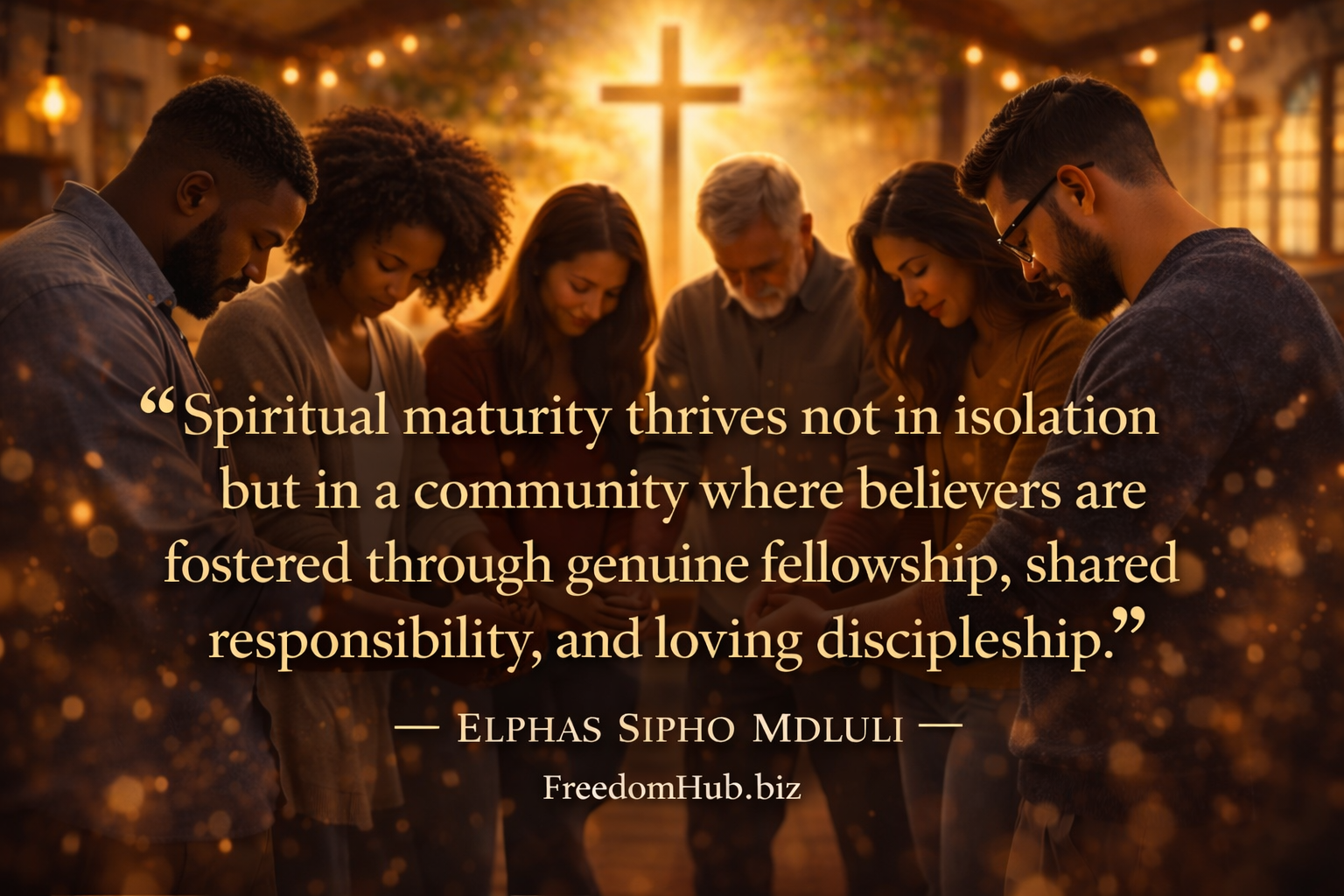
    Spiritual maturity rarely flourishes in isolation — it is strengthened within a community of ordered lives.

    Belonging is not emotional attachment. It is covenantal formation.

  • Rooted Together: Growing in Christ Through Community

    Believers praying together symbolizing spiritual growth in community
    Devotional • Church Life & Formation

    Rooted Together: Growing in Christ Through Community

    The life of faith grows strongest where believers remain connected—because maturity is formed through shared life in the Body of Christ.

    Theme: The life of faith grows strongest where believers remain connected.

    Hebrews 10:24 (NKJV) “And let us consider one another to provoke unto love and to good works…”

    Reflection

    Many of us earnestly pursue God in private. We pray alone, read Scripture alone, and seek personal holiness alone. Yet something feels incomplete. This is not weakness—it is divine design. God never intended spiritual maturity to flourish apart from the Body of Christ.

    Ecclesiastes 4:9–10 (NKJV) “Two are better than one… if they fall, one will lift up his companion.”

    God forms us not merely by what we know, but by where we live spiritually—in fellowship, shared responsibility, encouragement, and accountability with other believers. When we remain connected, our faith becomes anchored and resilient.

    Practice Shared Formation

    • Pray with other believers
    • Serve alongside others
    • Bear one another’s burdens
    • Speak truth in love
    • Commit to presence, not mere attendance

    Apply It

    Next Steps for Spiritual Growth in Community

    Choose one faithful step today. Belonging becomes stability when it is practiced consistently, not occasionally.

    Closing Thought

    Spiritual growth is not an isolated journey—it is cultivated where believers stay rooted together in Christ.

  • Spiritual Growth in Community: Why Belonging Matters

    Spiritual Growth in Community: Why Belonging Matters

    Believers praying together representing spiritual growth in community
    Church Life & Ministry • Pillar Teaching

    Spiritual Growth in Community: Why Belonging Matters

    Discover why authentic spiritual maturity is formed through shared life, fellowship, mentorship, and responsible participation—because spiritual growth was never designed to flourish alone.

    Focus Key Phrase: spiritual growth in community Tags: community, fellowship, church life, spiritual growth, belonging

    Many believers sincerely love God yet quietly attempt to grow in isolation, unaware that spiritual maturity was never designed to flourish alone. They attend when possible, listen to sermons, read Scripture privately, and pursue personal holiness—yet still experience a persistent tension: they are spiritually hungry, but relationally unrooted. The heart is sincere, but the life feels unstable. The faith is real, but the formation is inconsistent.

    When Spiritual Sincerity Meets Relational Unrootedness

    This internal tension often shows up in subtle ways:

    • You love Christ, but your spiritual life feels like a private project.
    • You can explain doctrine, yet struggle to sustain disciplined rhythms.
    • You desire purpose, but lack relational reinforcement and accountability.
    • You want to serve, but feel disconnected from shared responsibility.
    • You long for maturity, yet you keep meeting the limits of isolated growth.

    The church, in God’s wisdom, is not simply a gathering you attend; it is a spiritual environment designed to form you—to stabilize your faith, strengthen your responsibility, and mature your life through belonging, fellowship, mentorship, and Kingdom participation. This is why the church must function as a shepherding pathway, guiding a person from visitor to disciple, and from disciple to entrusted leader.

    Pastoral Recognition

    If you have attempted to grow alone, you are not unusual—and you are not condemned.

    Modern life trains people toward independence: busy schedules, fragmented relationships, private spirituality, and digital consumption. Many believers have also been wounded by church experiences and conclude, “I will keep my faith, but avoid deep involvement.” Others carry responsibility in work and family and assume that consistent participation in spiritual community is a luxury rather than a necessity.

    Yet the pattern of Scripture is clear: God saves individuals, but He forms a people. He does not merely rescue us from sin; He places us into a spiritual household where love becomes practice, holiness becomes embodied, and maturity becomes visible through shared life.

    So if you feel the tension—loving God but struggling to thrive in isolation—receive this as gentle wisdom: the answer is not guilt-driven attendance; the answer is Spirit-led belonging.

    Biblical Foundation

    Anchor Scripture — Hebrews 10:24–25 (NKJV)

    “And let us consider one another in order to stir up love and good works, not forsaking the assembling of ourselves together… but exhorting one another…”

    This is not a command to fill seats; it is a call to mutual strengthening. The phrase “consider one another” carries deliberate attention: believers are meant to think about each other’s growth and create conditions where love and good works become normal.

    Supporting Passages

    1. Acts 2:42–47 (NKJV) — The early church “continued steadfastly” in doctrine, fellowship, breaking of bread, and prayers. Doctrine and fellowship are companions: truth shapes community, and community embodies truth. The fruit was stability, generosity, shared life, and public credibility.
    2. Ephesians 4:11–16 (NKJV) — God gives leadership gifts “for the equipping of the saints… for the edifying of the body,” until believers grow into maturity. Growth is corporate strengthening; maturity happens as each part does its share.
    3. 1 Corinthians 12:12–27 (NKJV) — The church is the Body of Christ: integrated, interdependent, and strengthened through connection rather than detachment.
    4. John 13:34–35 (NKJV) — Love is practiced covenant in community; isolation may preserve comfort, but it cannot fully practice Christ’s command to love.
    5. Ecclesiastes 4:9–12 (NKJV) — Two are better than one: spiritual endurance is often strengthened through shared support and mutual lifting.

    Theologically, this means: the church is one of God’s primary instruments of formation. Not because God is limited, but because God is wise. He forms humility through relationships, faithfulness through consistency, maturity through responsibility, and love through fellowship. Spiritual growth is personal, but it is not private.

    Formation Framework

    Below is a structured framework to help you see how God forms believers through church life—not as mere attendance, but as a stabilizing environment of discipleship and responsibility.

    1) The Theology of Fellowship: More Than Friendship

    Biblical grounding: Acts 2:42; 1 John 1:7

    Fellowship in Scripture is not social warmth; it is shared participation in Christ. The term carries partnership, communion, and mutual investment. True fellowship includes encouragement, correction, prayer, truth-sharing, and practical care.

    Explanation: Friendship can be optional; fellowship is covenantal. Friendship may connect personalities; fellowship connects destinies in Christ. In fellowship, your faith becomes lived—not merely believed.

    Leadership insight: A church becomes spiritually stable when fellowship is structured, clear, and purposeful—so that believers are not drifting as anonymous attendees, but becoming known, strengthened, and formed.

    Life application: Ask yourself: Where am I spiritually known? Who can recognize when my joy is fading or my discipline is slipping? If the answer is “no one,” your growth is unnecessarily exposed.

    A practical next step is to spiritual growth in community through church connection.

    2) Mentorship as Spiritual Formation: Growth Has a Shape

    Biblical grounding: 2 Timothy 2:2; Titus 2:1–8

    Paul’s model is generational: what you received must be entrusted. Spiritual maturity is not only information; it is formation through guided practice and example.

    Explanation: Mentorship does not replace the Holy Spirit; it cooperates with the Holy Spirit. God often forms believers through wise voices, mature examples, and consistent shepherding. Many believers plateau not because they lack desire, but because they lack relational training.

    Leadership insight: In healthy church life, mentorship is not celebrity-driven. It is ordinary maturity made available—older helping younger, stable strengthening unstable, experienced guiding emerging.

    Life application: If you are newer to faith, begin with clarity and stability rather than self-directed complexity. A wise starting point is spiritual growth in community through start foundations.

    If you are already stable, consider: Who am I helping? Who am I strengthening? In the Kingdom, maturity becomes visible when you begin carrying others.

    3) Shared Responsibility in the Body: Formation Becomes Visible

    Biblical grounding: Ephesians 4:16; 1 Corinthians 12

    Scripture teaches that the Body is built up “as each part does its share.” In other words, contribution is not merely volunteering—it is a formation mechanism.

    Explanation: Many believers want growth without responsibility. Yet responsibility is often the furnace where maturity becomes real. When you serve, you learn patience. When you commit, you learn faithfulness. When you carry a role, you learn integrity. In shared responsibility, character is tested and strengthened.

    Leadership insight: A church is not strong because it has gifted individuals; it is strong because it has formed disciples—people who carry responsibility with humility and consistency.

    Life application: Your question should not only be “What did I receive today?” but also “What am I building with my life?” The church becomes stable when believers see themselves not as consumers, but as contributors to spiritual culture.

    To explore meaningful participation within the Body, take your next step toward spiritual growth in community through church connection.

    4) Stability Through Belonging: The Church as a Spiritual Environment

    Biblical grounding: Psalm 92:13–14; Hebrews 3:13

    “Those who are planted in the house of the LORD… shall still bear fruit.” Planting is not casual visiting; it is rootedness. Stability grows where believers are consistently present within a healthy spiritual environment.

    Explanation: Belonging does not mean perfection; it means covenantal presence. It is the decision: “I will be formed here. I will grow here. I will be strengthened here.” In such an environment, spiritual habits become sustainable because the community supports your growth.

    Leadership insight: When the church functions as a shepherding pathway (not an announcement platform), it helps people move from uncertainty to clarity, from isolation to family, and from attendance to discipleship.

    Life application: If your spiritual life is unstable, do not only adjust your private routine—also strengthen your spiritual environment. God often matures believers by placing them among ordered, faithful people.

    If you want a clear, structured starting point for growth, you can spiritual growth in community through discipleship pathway.

    5) Community That Strengthens Calling: Maturity Before Influence

    Biblical grounding: Acts 13:1–3; 1 Peter 5:2–3

    Calling is strengthened in community. Even Paul and Barnabas were sent from a gathered spiritual environment. Mature calling is not self-appointed; it is recognized, tested, and entrusted.

    Explanation: Many believers feel called, but remain unformed. Community provides testing: consistency, humility, teachability, and service. This is protection, not limitation. Calling without formation produces strain; calling with formation produces fruit.

    Leadership insight: Healthy church life does not rush people into platforms; it forms them into responsibility. The goal is not visibility; it is maturity.

    Life application: Ask: Is my life stable enough to carry the influence I desire? If not, your next step is not to promote your gift—it is to deepen your formation through belonging and service.

    Ordered Life Integration: Why Structure Protects Spiritual Maturity

    Stable communities are built by believers whose lives are intentionally ordered.

    An ordered life is not rigid control; it is spiritual alignment—placing your commitments under God’s governance. When a believer’s life lacks structure, everything becomes reactive: attendance becomes inconsistent, prayer becomes occasional, service becomes optional, and relationships become shallow.

    But when life is ordered:

    • Consistency becomes possible.
    • Accountability becomes normal.
    • Growth becomes measurable.
    • Responsibility becomes joyful rather than burdensome.

    This is one of the quiet reasons church life matters: community strengthens order. The rhythms of worship, fellowship, discipleship, and serving become rails that guide your life into maturity.

    If you want clarity about spiritual foundations and doctrine that supports ordered living, ground yourself in spiritual growth in community through doctrinal foundations.

    Practical Formation Guidance

    The goal is not inspiration—it is participation through consistent rhythms. Below are practical steps that move you from isolated sincerity into embodied formation.

    Reflection Questions

    1. Where have I been trying to mature alone, without meaningful spiritual relationships?
    2. What pattern do I repeat when my life becomes pressured—withdrawal, inconsistency, or drifting?
    3. What would stable belonging look like for my family, my faith, and my future?
    4. Who has permission to speak truth into my life with love and clarity?
    5. In what practical way can I begin carrying responsibility within the Body?

    Relational Practices

    • Choose one consistent community rhythm (weekly worship and fellowship) and protect it like spiritual oxygen.
    • Move from anonymity to presence by learning names, serving practically, and practicing “consider one another” (Hebrews 10).
    • Practice spiritual conversation, not only social conversation: ask believers how they are doing in prayer, Scripture, and obedience.
    • Invite correction by asking a mature believer, “What do you see in me that I should strengthen?”

    Community Engagement Steps

    Mentorship Encouragement

    Mentorship begins with humility and consistency. It is difficult to mentor someone who appears and disappears. If you desire guidance, begin by becoming present, dependable, and teachable.

    Leadership Applications

    • Do not measure growth by how much you know; measure it by how consistently you obey.
    • Do not chase influence; pursue formation.
    • Do not rush for platforms; commit to serving.

    Leaders are formed where character is tested—inside faithful community.

    Why Spiritual Growth Was Never Meant to Happen in Isolation

    Spiritual growth becomes sustainable when it moves from a private intention to a shared environment. A believer may love God deeply, yet still lack the structure that makes faith resilient over time. Community supplies what isolation cannot:

    • Reinforcement: others strengthen your resolve when pressure increases.
    • Correction: loving truth prevents slow drift.
    • Rhythm: consistent gatherings and shared practices stabilize the soul.
    • Responsibility: serving turns faith into embodied maturity.
    • Family: belonging heals the “unanchored believer” experience.

    This is why a healthy church does not merely host services; it shepherds a journey—from visitor to believer, from believer to growing member, from growing member to serving disciple, and from serving disciple to entrusted leader.

    Three Directional Invitations

    1) Intellectual Formation — Freedom Hub
    Those who desire deeper clarity may continue exploring structured teachings through Freedom Hub, where biblical understanding is strengthened through orderly, formation-focused resources: spiritual growth in community through Freedom Hub learning.

    2) Embodied Formation — Church
    If you are ready to move beyond attendance into spiritual family, take a simple next step and begin spiritual growth in community through church connection.

    3) Structured Growth — Patreon
    For believers seeking intentional spiritual development through guided formation rhythms and practical growth structure, you may consider the Purpose, Stewardship & Growth Mentorship Community as a disciplined environment for strengthening daily life: spiritual growth in community through guided formation community.

    Next Steps for Spiritual Growth in Community

    Choose one faithful step this week. Belonging becomes stability when it is practiced consistently, not occasionally.

    Leadership Closing

    Spiritual maturity rarely flourishes in isolation — it is strengthened within a community of ordered lives.

    community fellowship church life spiritual growth belonging

  • Delayed Obedience Is Disobedience: When the Word Must Become a Way of Life

    Delayed Obedience Is Disobedience: When the Word Must Become a Way of Life

    Teaching & Sermons Formation-driven sermon article

    Delayed Obedience Is Disobedience: When the Word Must Become a Way of Life

    Many believers hear truth faithfully, yet still struggle with delayed response and selective surrender. This article turns sermon truth into structured formation—so the Word becomes lived obedience, not admired insight.

    Sermon Theme: Advancing Through Obedience
    Anchor Text: 1 Samuel 15:22–23 (NKJV)
    Supporting: Isaiah 1:19 (NKJV)
    Open Bible beside a journal and pen representing ordered response and timely obedience

    Calm, natural-light imagery symbolizing timely obedience and ordered response.

    1) Opening — Name the Internal Tension

    Many believers faithfully hear sermons yet quietly wonder why lasting transformation sometimes feels slower than expected. They listen attentively, agree with the truth, even feel convicted—yet the same patterns return: postponed repentance, selective surrender, inconsistent spiritual discipline, and an inner sense that growth is real but not yet stable.

    This tension is not a lack of information. It is often the gap between hearing and responding, between admiration of truth and submission to truth. In that gap, the heart learns a dangerous habit: delay.

    2) Pastoral Recognition

    It is wise to admit this openly: hearing truth is the beginning, not the finish. A sermon can awaken the conscience, clarify Scripture, and strengthen faith. But formation requires something more than insight—it requires ordered response.

    There is no shame in acknowledging the struggle. The danger is not that you are tempted to delay; the danger is that delay becomes normal. Spiritual life is not shaped only by what we believe, but also by what we obey, what we practice, and what we repeatedly choose when God’s instruction becomes specific.

    If you desire steady growth, you are not merely looking for stronger emotions in worship. You are looking for stronger alignment in daily life.

    Opening Illustration

    A young child is told by his father, “Don’t run into the street.” The father sees a car coming. The child hears the command—but hesitates. He pauses, calculates, wonders if he has time. One second feels small. But in that second, danger draws near.

    Delayed obedience in that moment is not harmless—it is dangerous.

    Often, we treat God’s instructions the same way. We don’t say “no.” We just say, “Not yet.” We intend to obey. We plan to obey. But we delay. And in our delay, we drift.

    This reveals something deep about the human heart: we struggle to trust fully. We want control. We want convenience. We want clarity before surrender. And that is why we need Christ—not merely as an example of obedience, but as the Savior who changes our hearts and empowers us to obey.

    3) Sermon Big Idea

    God does not call His people merely to listen to truth—but to be ordered by it.

    This is the governing idea: sermons are not spiritual entertainment, and they are not only educational moments. They are invitations into alignment, calls into discipline, instructions for stewardship, and training toward faithful influence.

    4) Biblical Foundation

    Anchor Scripture: 1 Samuel 15:22–23 (NKJV)

    Samuel confronts Saul with a statement that reveals heaven’s priority: God values obedience above religious activity. Saul offered sacrifices, but he did not obey fully. He remained outwardly spiritual while inwardly resistant. Scripture exposes this as a leadership failure rooted in a deeper spiritual disease: partial obedience.

    Saul did not completely reject God—he partially obeyed. He adjusted God’s command to fit his reasoning. He delayed full obedience. And heaven called it disobedience.

    Why do believers struggle here?

    • We fear what obedience may cost.
    • We assume partial obedience is sufficient.
    • We believe delayed obedience is still obedience.

    But Christ stands at the center of this issue. He is the perfect model of obedience. He is the One who fulfilled what we failed to do. And He is the One who empowers us to walk in obedience today.

    Supporting Passages (with interpretation)

    Hebrews 3:15 (NKJV)

    “Today… do not harden your hearts.”

    The word today matters because it exposes the moral nature of delay. When God speaks, delayed response is rarely neutral; it often becomes the first stage of hardening.

    James 1:22–25 (NKJV)

    “Be doers of the word, and not hearers only.”

    James frames hearing without obedience as self-deception. The issue is not ignorance; it is refusal to let truth govern the will.

    Luke 6:46 (NKJV)

    “Why do you call Me ‘Lord, Lord,’ and not do the things which I say?”

    Jesus exposes a contradiction: confessing His Lordship while resisting His commands. This is not a minor inconsistency; it is a spiritual fracture.

    John 14:21 (NKJV)

    “He who has My commandments and keeps them… loves Me.”

    Jesus ties obedience to love—not as legalism, but as relational reality. Obedience is not how we earn His love; it is how we express that we trust Him.

    Isaiah 1:19 (NKJV)

    “If you are willing and obedient, you shall eat the good of the land.”

    Scripture connects willingness (heart posture) with obedience (visible action). God’s promises are often experienced through aligned response, not delayed negotiation.

    Conclusion: obedience is spiritual structure, and timing is part of obedience.

    5) Scriptural Exposition (Core Teaching)

    Movement 1 — Hearing vs. Becoming: Truth Must Move from Mind to Will

    Explanation: Hearing a sermon can produce recognition, conviction, and understanding. But formation begins when truth becomes a decision, then a pattern, then a way of life. Many believers want spiritual depth while remaining hesitant to restructure their habits.

    Biblical grounding: James 1 warns that hearing without doing becomes self-deception. You can sincerely admire truth while quietly refusing its demands.

    Leadership insight: Leaders are not formed by what they know alone. They are formed by what they consistently obey. Private compromise produces public instability. Private alignment produces public clarity.

    Practical implication: After every sermon, ask: What must change this week—not in theory, but in practice? The Word becomes spiritual power in the life that responds.

    Movement 2 — Timing Matters to God: “Today” Is a Spiritual Word

    Explanation: We often delay because we want control—control of outcomes, control of cost, control of timing. But Scripture repeatedly uses present-tense language when calling for repentance, forgiveness, reconciliation, and surrender. God’s instruction is frequently immediate because our hearts drift quickly.

    Biblical grounding: Hebrews 3:15 uses today because delay hardens the heart. Saul’s failure was not only what he did, but how he adjusted God’s command to fit his reasoning and schedule.

    Leadership insight: Delayed obedience is often disguised as maturity: “I’m still processing.” Sometimes processing is real. But often it is avoidance dressed in respectable language. A disciplined disciple can distinguish between wise counsel and fearful postponement.

    Practical implication: When God speaks clearly—about forgiveness, integrity, repentance, humility—respond while the heart is soft. Do not wait until the conscience is quiet. Quiet conscience is not always peace; it may be numbness.

    Movement 3 — Partial Obedience Is Rebellion: Selective Surrender Is Still Resistance

    Explanation: Saul spared what God told him to destroy. He obeyed enough to look faithful, but he kept what seemed valuable. This is the anatomy of partial obedience: we surrender what costs little and protect what we love too much.

    Biblical grounding: 1 Samuel 15:23 calls rebellion and stubbornness spiritual matters, not merely personality traits. Selective obedience places human judgment above divine authority.

    Leadership insight: Partial obedience is especially dangerous for emerging leaders because it trains people to manage spiritual appearance while avoiding spiritual truth. Over time, this produces a leadership culture that is impressive but unreliable.

    Practical implication: Identify your “protected area”—the one instruction you keep renegotiating. That is often the very area Christ intends to govern, not to shame you, but to free you.

    Movement 4 — Alignment Before Increase: God Strengthens What He Orders

    Explanation: Many want increased influence, deeper anointing, greater effectiveness, and stronger impact—yet resist the simple obedience that orders the inner life. Scripture shows a pattern: God establishes private order before public increase.

    Biblical grounding: Jesus’ words in Luke 6:46 confront the gap between confession and compliance. God’s order is not primarily about external rules; it is about internal alignment that produces stable obedience.

    Leadership insight: Influence without order creates damage. An “open door” without discipline becomes an open exposure. God’s love protects us by insisting on alignment before expansion.

    Practical implication: Treat obedience as your first leadership qualification. Before asking God for more responsibility, ask: Is my private life governed by what He already said?

    Movement 5 — Christ at the Centre: Obedience Is Not Willpower; It Is Spirit-Empowered Trust

    Explanation: This teaching is not condemnation—it is invitation. Saul reveals what human nature does when it wants control. Christ reveals what true sonship does when it trusts the Father. Jesus obeyed fully—without negotiation—because His trust was complete.

    Biblical grounding: John 14:21 shows that obedience flows from love, and love flows from relationship. The gospel does not merely demand obedience; it gives a new heart and the Spirit’s help.

    Leadership insight: Strong discipleship never produces self-salvation projects. It produces Christ-dependence: “Lord, I will obey because You have saved me, and You now empower me.”

    Practical implication: When you feel the cost of obedience, do not stare at the cost. Look at Christ. Obedience becomes possible when trust becomes stronger than fear.

    6) Leadership Implications

    • Private order produces public stability. People trust leaders whose inner life is governed, not impulsive.
    • Spiritual maturity strengthens communities. Unstable believers create unstable teams; disciplined disciples become dependable servants.
    • Disciplined believers become safe carriers of influence. If your obedience is selective, your influence will be unpredictable. If your obedience is ordered, your influence becomes trustworthy.

    For a church to remain spiritually healthy, sermons must not become archives. They must function as shepherding tools that lead to practical response and clear next steps.

    7) Ordered Life Application

    In Ordered Life language, delayed and partial obedience disrupt four pillars:

    Alignment

    You cannot remain aligned to Christ while continually postponing His instructions.

    Discipline

    Delay trains inconsistency. Immediate obedience trains stability.

    Stewardship

    The heart that delays God’s Word will also mishandle time, relationships, and responsibility.

    Influence

    Influence grows safest when submission grows deepest.

    Obedience is not merely a spiritual moment. It is a governance system for the soul.

    8) Practical Formation Guidance

    Inspiration becomes transformation through consistent response. Use the following practices for the next 14 days.

    Reflection Questions

    • What instruction from God have I delayed, even though I call Him Lord?
    • Where have I obeyed publicly but compromised privately?
    • What fear is fueling my hesitation—loss, rejection, discomfort, exposure, or change?
    • What would “today obedience” look like in one concrete step?

    Spiritual Practices (Simple and Repeatable)

    1. Two-Minute Obedience Audit (Daily): Each evening, write one sentence: “Today I obeyed God in…” and one sentence: “Today I resisted God in…” Keep it honest, not dramatic.
    2. Scripture Rehearsal (3 times a week): Read 1 Samuel 15:22–23 and Hebrews 3:15 slowly. Then write: “What does this require of my timing and my surrender?”
    3. Prayer of Surrender (Daily): “Lord, I trust You. I will not negotiate what You have made clear. Make my heart willing and my response immediate.”

    Journaling Prompts

    • “If I obeyed fully, the new pattern in my life would be…”
    • “The hidden cost I fear is…”
    • “Christ has already obeyed perfectly on my behalf; therefore I can trust Him with…”

    Obedience Steps (Choose One This Week)

    • Initiate reconciliation you have postponed.
    • End a compromise you keep justifying.
    • Return to a discipline you abandoned (prayer rhythm, Scripture reading, integrity with finances, purity boundaries).
    • Seek counsel where pride has kept you isolated.

    Leadership Application

    If you serve in any ministry capacity, write down: “The one area where my example must become more consistent is…” Then choose one measurable practice that strengthens your integrity.

    Strong Call to Action (Dignified, Not Urgent)

    If you hear His voice today, do not harden your heart. This is not a call to pressure; it is a call to clarity. The Lord is not trying to shame you—He is trying to stabilize you.

    • Where have you delayed?
    • Where have you partially obeyed?
    • Where has God spoken clearly, yet you postponed?

    Return with honesty. Trust Christ fully. Surrender control completely. Step into obedience now—not as panic, but as alignment.

    Short Prayer

    Heavenly Father,

    We thank You for Your Word that calls us higher. Forgive us for every delay and every area of partial obedience. Cleanse our hearts from stubbornness and fear. Lord Jesus, You obeyed perfectly where we have failed—teach us to trust You fully. Holy Spirit, help us respond quickly when You speak. Give us willing hearts and courageous faith to obey today. In Jesus’ name, Amen.

    Declarations

    1. I choose immediate obedience—when God speaks, I respond.
    2. I reject partial obedience and surrender fully to Christ.
    3. My heart is willing, soft, and sensitive to the voice of the Lord.
    4. Through Christ, I have the grace and strength to obey completely and walk in God’s promises.

    Three Directional Invitations

    1) Intellectual Depth — Freedom Hub

    Those desiring to continue growing in biblical understanding may explore the structured teaching resources available through structured biblical resources for serious believers, where formation is treated as ordered learning, not shallow inspiration.

    Recommended when you want clarity, structure, and deeper biblical understanding.

    2) Spiritual Embodiment — Church

    If you want truth to become lived practice, do not walk alone. You can connect with our church community and enter our structured discipleship pathway where growth is guided intentionally—from belief into mature followership.

    For doctrinal clarity, revisit our statement of faith and beliefs. For structured early-stage growth, start a foundations journey. For counsel and prayer support, reach our pastoral team.

    3) Guided Formation — Patreon

    For believers who desire structured, intentional growth through practice and accountability, the guided formation community for daily spiritual order exists as a space for consistent patterns, spiritual discipline, and measured progress.

    Choose one next step that matches your season

    If obedience has been delayed, begin with foundations and community support. If obedience has been selective, seek counsel and rebuild alignment with Scripture and practice.

    Leadership Closing: You do not drift into maturity by hearing truth—you grow into it by living what God has spoken.

  • Obedience Is a Kingdom Accelerator: Quotes & Declarations for Ordered Growth

    Obedience Is a Kingdom Accelerator: Quotes & Declarations for Ordered Growth

    Church • Quotes & Declarations

    Obedience Is a Kingdom Accelerator: Quotes & Declarations

    A formation-focused collection of quotes and declarations drawn from the teaching on obedience, alignment, and steady spiritual advancement in Christ— designed for disciplined believers who desire mature growth within the life of the Church.

    Theme: Advancing Through Obedience Focus: Order & Alignment Use: Prayer • Confession • Formation
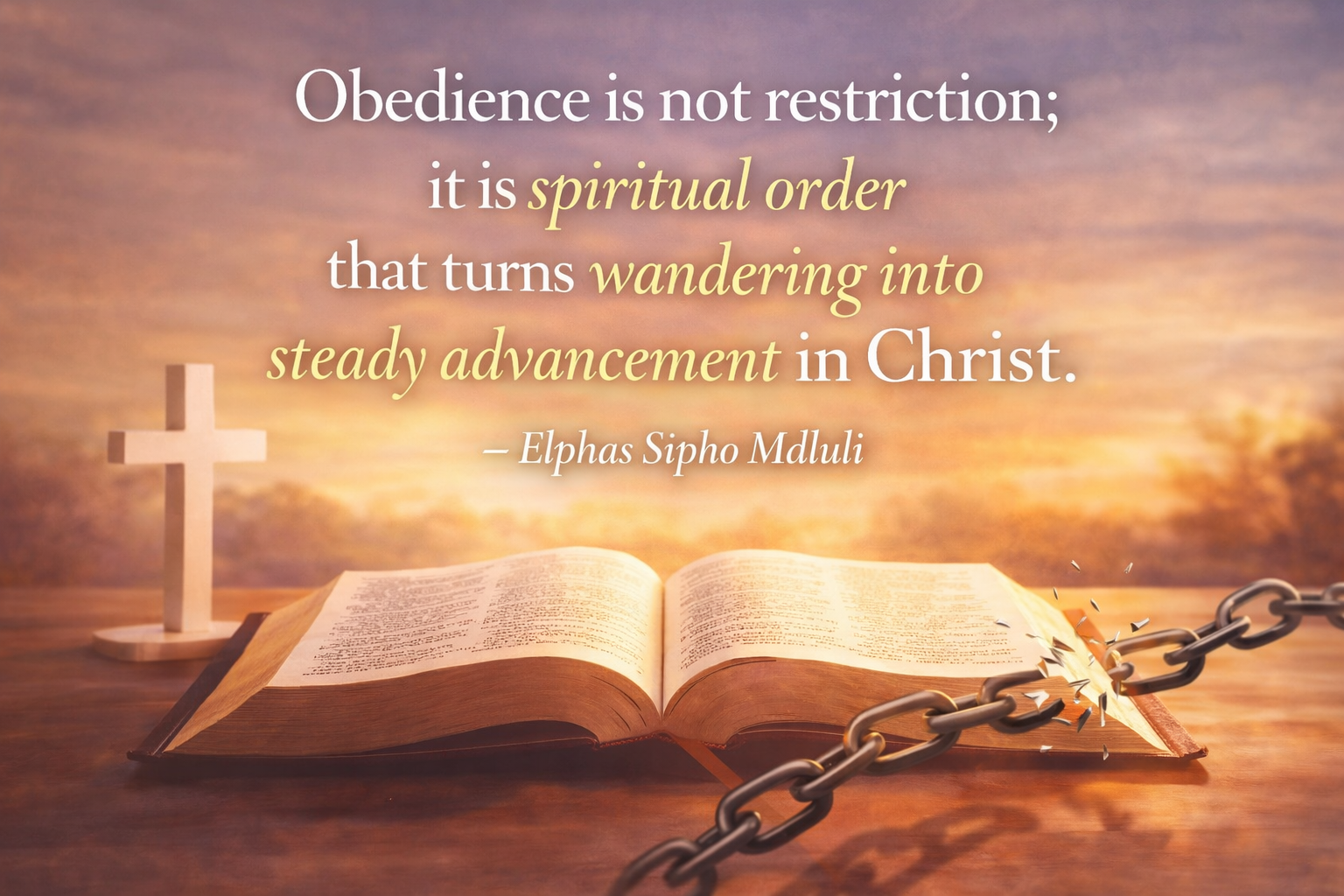
    Main Quote (Hero Image):
    “Obedience is not restriction; it is spiritual order that turns wandering into steady advancement in Christ.”
    — Elphas Sipho Mdluli
    Open Bible with an obedience quote overlay, symbolising spiritual order and steady advancement in Christ.

    How to Use These Quotes & Declarations

    Use the quotes for meditation and journaling. Speak the declarations slowly, as formed prayers—meant to build steady alignment rather than emotional intensity. If you are seeking a structured growth pathway inside the Church, begin with Start Foundations, and continue through the Discipleship Pathway.

    12 Quotes for Spiritual Order & Advancement

    Read one quote per day, then write one obedience step that makes it concrete.

    Quote 1

    “Spiritual growth becomes steady when obedience becomes a practiced response, not an occasional moment.”

    — Elphas Sipho Mdluli
    Quote 2

    “Hearing truth is the doorway; obedience is the structure that makes truth livable.”

    — Elphas Sipho Mdluli
    Quote 3

    “God’s direction is not a limitation—His voice is the path that protects your progress.”

    — Elphas Sipho Mdluli
    Quote 4

    “Alignment precedes advancement; increase without order becomes instability.”

    — Elphas Sipho Mdluli
    Quote 5

    “Delayed obedience often looks like waiting, but it quietly extends the journey.”

    — Elphas Sipho Mdluli
    Quote 6

    “Obedience reduces resistance, and reduced resistance feels like acceleration.”

    — Elphas Sipho Mdluli
    Quote 7

    “You cannot build mature discipleship on inspiration alone—obedience is the rhythm that sustains growth.”

    — Elphas Sipho Mdluli
    Quote 8

    “Private order produces public stability; a disciplined heart becomes a refuge for others.”

    — Elphas Sipho Mdluli
    Quote 9

    “God does not bless disorder to prove love—He forms order to protect your future.”

    — Elphas Sipho Mdluli
    Quote 10

    “Obedience is love made visible—faith becomes reliable when it becomes practiced.”

    — Elphas Sipho Mdluli
    Quote 11

    “Christ enables obedience from within; formation is not self-effort, it is Spirit-empowered alignment.”

    — Elphas Sipho Mdluli
    Quote 12

    “The reward of obedience is not only what God gives, but the clarity of who He reveals.”

    — Elphas Sipho Mdluli

    Declarations for Steady Spiritual Growth

    Speak these declarations as a measured practice. If you need guidance or prayer support while taking a step of obedience, reach out through Prayer & Pastoral Care.

    1. I declare that I hear the voice of the Lord with clarity, and I respond with faithful obedience.
    2. I declare that obedience orders my life, and my spiritual growth becomes steady and measurable.
    3. I declare that every form of resistance is broken, and my heart yields quickly to Christ.
    4. I declare that my obedience shortens unnecessary detours, and I will not wander in delay.
    5. I declare that alignment comes before increase, and my life will carry God’s blessings with maturity.
    6. I declare that my private life is disciplined, and public stability will be the fruit of obedience.
    7. I declare that truth is not only heard by me; it is practiced by me until it forms my character.
    8. I declare that Christ strengthens me from within, and my obedience flows from love, not pressure.
    9. I declare that my schedule reflects my spiritual priorities, and my time is redeemed for God’s purpose.
    10. I declare that obedience sharpens my spiritual sensitivity, and I recognize the Lord’s leading.
    11. I declare that I belong to a forming community, and I grow through worship, accountability, and service.
    12. I declare that I will not drift into maturity; I will grow into it by living what God has spoken.

    Grow Deeper

    Take Your Next Step in Spiritual Growth

    Growth in Christ is intentional. Choose a pathway that strengthens your foundation and develops consistency in your walk with God.

    Leadership Closing: You do not drift into maturity by hearing truth—you grow into it by living what God has spoken.
    If you are ready to belong and build consistency, begin by connecting with our church community, and plan your visit through our branches.
  • Obedience Is the Pathway to Spiritual Advancement

    Devotionals • Church Formation

    Obedience Is the Pathway to Spiritual Advancement

    A calm devotional for believers who desire steady growth: obedience as alignment with God’s voice, ordered discipleship, and mature spiritual movement in Christ.

    Key Scripture: Isaiah 1:19 Anchor: Deuteronomy 28:1 Focus: Order & Alignment Reading: 4–6 min
    Big Idea: Spiritual advancement is rarely a mystery of emotion—more often, it is the fruit of obedience that brings order to the heart.
    Open Bible in gentle natural light symbolising obedience, alignment with God’s voice, and steady spiritual advancement.

    When Progress Feels Slower Than Expected

    Many believers desire spiritual growth, yet quietly wonder why certain patterns persist and why transformation can feel slower than expected. This question is not rebellion; often it is hunger for maturity.

    Today’s devotional offers a stable answer: progress often becomes clearer when obedience is treated as alignment—practiced, consistent, and Spirit-enabled.

    Scripture for Today

    “If you are willing and obedient, you shall eat the good of the land.” — Isaiah 1:19 (NKJV)

    “Obedience does not shrink your life; it orders your steps—so God’s purposes can unfold with steady clarity.”
    — Elphas Sipho Mdluli

    Willingness speaks to posture. Obedience speaks to alignment. Together, they form a life that can carry growth without collapse. If you want to anchor obedience in doctrine rather than mood, revisit our foundational beliefs.

    Two Quiet Realities of Obedience

    1) Obedience reduces unnecessary detours

    God’s direction is not confinement—it is guidance. When we obey promptly, growth becomes steadier, because resistance no longer adds distance to the journey.

    2) Obedience strengthens spiritual clarity

    Obedience forms spiritual sensitivity. As a believer consistently responds to God’s leading, the heart becomes trained to recognize what God is doing and to participate without confusion.

    Pastoral note: If you need prayer support or wise counsel as you take a step of obedience, connect with Prayer & Pastoral Care.

    A Simple Formation Practice

    Choose one obedience step for the next 7 days. Keep it measurable and calm.

    • Alignment prayer (2 minutes daily): “Lord, align my will with Yours today.”
    • One prompt response: when convicted, take one concrete action within 24 hours.
    • Weekly review: identify where resistance appeared and what obedience would look like next.

    Reflection Questions

    1. Where do I delay obedience while calling it “waiting”?
    2. What has God already made clear that I keep postponing?
    3. What would change in 30 days if I practiced one obedience step consistently?

    When you are ready for a clearer growth structure, the church’s Discipleship Pathway provides a steady progression from foundations to formation and service.

    Obedience Grows Best in Community

    Spiritual maturity is rarely formed in isolation. It becomes visible through worship, accountability, and service. If you are seeking a spiritual home, begin by connecting with our church community, and consider planning your visit through our branches.

    For deeper relational structure and guidance, explore Community Mentorship and the Formation Class.

    Prayer

    Lord Jesus, align my heart with Your will. Give me grace to obey from love, not pressure. Where I have delayed, restore steadiness. Form my life into spiritual order, and let my growth glorify You. Amen.

    Leadership Closing: You do not drift into maturity by hearing truth—you grow into it by living what God has spoken.

    Optional resource for deeper reflection: Download the related sermon PDF .

  • The Difference Between Believing and Being Formed: Why Spiritual Maturity Requires Structure

    The Difference Between Believing and Being Formed: Why Spiritual Maturity Requires Structure

    Discipleship & Spiritual Growth • Formation Guide

    The Difference Between Believing and Being Formed: Why Spiritual Maturity Requires Structure

    Many believers have sincere faith, yet quietly sense a lack of spiritual structure. This guide clarifies the difference between believing and being formed—and outlines a pathway toward stable Christian maturity.

    Focus: believing vs spiritual formation Keywords: discipleship • maturity • structure Theme: ordered life
    Open Bible and journal representing spiritual formation and Christian maturity
    Spiritual maturity begins when belief is shaped into structure.

    Key Takeaways

    • Believing begins the journey; spiritual formation builds maturity through repeated rhythms and obedience.
    • Structure is not legalism; it is love expressed through consistent practice under Christ.
    • Discipleship grows best in community; formation is strengthened through guidance, accountability, and belonging.

    1) Magnetic Opening — Name the Internal Tension

    Many believers genuinely love God, affirm the truths of Scripture, and can describe the moment they first believed—yet quietly sense that their spiritual lives lack structure. They pray, but inconsistently. They attend church, but without a clear pathway. They read the Bible, but without a rhythm that shapes their mind and habits. Over time, a tension forms: “If I truly believe, why do I still feel spiritually unsteady?”

    This is not the tension of hypocrisy. It is the tension of sincerity without formation—faith without an ordered way of life. It is the gap between conversion and maturity, between agreeing with truth and being shaped by truth. And for spiritually serious believers, that gap becomes increasingly uncomfortable, because the Spirit stirs a desire not merely to know Christ, but to become like Him.

    Believing vs Spiritual Formation: What Changes After Conversion?

    Conversion brings real life—new birth, forgiveness, reconciliation with God. Yet the New Testament consistently shows that new life is meant to be formed into a stable way of living. Believing is the entrance; formation is the building process. One can sincerely believe and still remain spiritually reactive, because maturity grows through repeated practice, structured obedience, and life lived within discipleship.

    When belief is not formed, faith often stays in the realm of intention. But when belief is formed, faith becomes embodied: Scripture shapes decisions, prayer becomes rhythm rather than rescue, and obedience becomes architecture rather than mere restriction. This is where Christian maturity begins to appear—not as spiritual performance, but as spiritual stability.

    2) Pastoral Recognition

    If you recognize yourself here, you are not alone—and you are not necessarily failing. Often, this tension is an invitation into the next stage of discipleship.

    In many seasons, believers interpret the lack of progress as personal weakness: “Maybe I’m not disciplined enough.” But Scripture reveals something more hopeful: spiritual growth is not meant to be sustained by willpower alone. God forms His people through means—through Word, community, practices, obedience, and repeated rhythms that reshape the heart over time.

    A believer can be sincere and still be unformed. A believer can be saved and still be unstable. Not because salvation is incomplete, but because maturity requires development. The Christian life is not only a message to believe; it is a life to be built.

    Formation Question

    So the question is not merely, “Do I believe?” The deeper question is: “Am I being formed?”

    3) Biblical Foundation

    Anchor Scripture — Romans 12:1–2

    Romans 12:1–2 calls believers to present themselves to God and to be “transformed” by the renewing of the mind. This is not a one-time decision. It is a lifelong process. The language of transformation implies ongoing formation—an inner reshaping that results in a different way of living and discerning.

    Believing begins the journey. Formation sustains and matures it.

    Supporting Scriptures (with theological clarity)

    1

    James 1:22–25 — The Word must be done, not only heard.

    James confronts the danger of spiritual familiarity without obedience. Hearing without doing forms a self-deception: the believer feels nourished without actually being changed. Formation requires embodied response—truth practiced until it becomes part of us.

    2

    Ephesians 4:11–16 — Maturity is grown within a discipled community.

    Paul describes the church as a formation environment where leaders equip the saints, and believers mature “to the measure of the stature of the fullness of Christ.” Maturity is not merely private improvement. It is corporate development—shaped by teaching, modeling, correction, and shared life.

    3

    Luke 6:46–49 — Obedience is the foundation that withstands storms.

    Jesus distinguishes between those who hear His words and those who do them. The obedient person is compared to a builder who digs deep and lays a foundation. This teaches that stability is not produced by inspiration; it is produced by structured obedience.

    4

    1 Timothy 4:7–8 — Godliness involves training.

    Paul’s instruction is direct: “Train yourself for godliness.” Training assumes structure, repetition, and deliberate effort. Grace is not opposed to effort; it is opposed to earning. Formation is the fruit of grace applied through disciplined practice.

    5

    Colossians 1:28–29 — The goal of ministry is mature believers.

    Paul’s aim is not simply converts, but believers presented “mature in Christ.” Maturity is the intended outcome of Christian teaching and shepherding. This means it is possible to remain immature—and it is also possible to grow, through a clear pathway.

    Summary: Faith is received by believing, but maturity is built through formation. Belief opens the door. Formation builds the house.

    4) Formation Framework (Core Section)

    To understand the difference between believing vs spiritual formation, it helps to see discipleship as a structured journey rather than a vague intention. Below are five movements that guide believers from sincere faith into stable maturity.

    1

    Movement 1: Conversion Gives Life; Formation Gives Shape

    Explanation: Believing in Christ brings new life—new birth, forgiveness, reconciliation with God. But new life must be given shape, just as a child must be nurtured into adulthood. Without formation, believers often remain spiritually reactive: strong emotions in worship, deep conviction after sermons, yet little lasting change in habits, speech, relationships, or stewardship.

    Biblical grounding: Jesus speaks of being born again (John 3:3–6)—the beginning. But He also commands disciples to learn His way of life (Matthew 11:28–30), taking His yoke—an image of shared discipline and guided formation.

    Leadership insight: Leaders regularly observe this: believers can be highly responsive to spiritual moments while remaining unstructured in daily life. Over time, instability is not cured by more emotion, but by clearer formation.

    Life application: Ask yourself: Has my faith given me a new identity—but have I built a new pattern of living? Formation is where identity becomes practice.

    2

    Movement 2: Foundations Before Increase

    Explanation: Many believers want spiritual power, deeper revelation, and stronger authority, but resist foundational disciplines. Yet the Christian life is built in order. Depth is not achieved by intensity; it is achieved by roots.

    Biblical grounding: Paul speaks of being “rooted and built up” (Colossians 2:6–7). Rooted first. Built up next. In the parable of the soils (Mark 4:14–20), growth is hindered not by lack of seed, but by shallow soil and competing thorns. Formation is the work of deepening the soil.

    Leadership insight: The church is often asked to deliver mature outcomes without foundational processes. But discipleship is not magic—it is cultivation. Where foundations are missing, leaders should not shame believers; they should offer pathways.

    Life application: If you feel spiritually inconsistent, do not start by chasing more complexity. Start by rebuilding foundations: Scripture intake, prayer rhythm, fellowship, obedience, accountability.

    3

    Movement 3: Spiritual Rhythm Is the Home of Maturity

    Explanation: A rhythm is not legalism. It is love structured over time. Without rhythm, believers live by spiritual impulse: they engage when they feel stirred and withdraw when they feel tired. But maturity requires a stable cadence—daily, weekly, and seasonal patterns that keep the heart warm and the mind renewed.

    Biblical grounding: Jesus practiced regular withdrawal for prayer (Mark 1:35), attended synagogue “as was His custom” (Luke 4:16), and taught persistent prayer (Luke 18:1). The early church devoted themselves to practices (Acts 2:42)—teaching, fellowship, breaking of bread, prayers. Devotion implies structure.

    Leadership insight: Rhythm protects believers from the tyranny of mood. It creates spiritual predictability: not mechanical, but faithful. It is how belief becomes a formed life.

    Life application: Build a simple rhythm you can sustain:

    • Daily: Scripture + prayer (even short, but consistent)
    • Weekly: gathered worship + fellowship + reflection
    • Monthly: extended review of your spiritual direction
    • Seasonal: fasting, retreat, or renewed consecration

    This is not about doing more. It is about doing what matters, consistently.

    4

    Movement 4: Obedience Is Structure, Not Mere Restriction

    Explanation: Many believers see obedience as limitation. But biblically, obedience is architecture. It is the visible form of love. When obedience is missing, spiritual life becomes abstract—belief without embodiment.

    Biblical grounding: Jesus says, “If you love Me, you will keep My commandments” (John 14:15). He also warns that hearing without doing produces collapse (Luke 6:49). Obedience is not the enemy of intimacy; it is the shape of intimacy.

    Leadership insight: A common discipleship breakdown occurs when believers want spiritual experiences but resist God’s instructions in relationships, integrity, sexuality, speech, finances, forgiveness, and stewardship. Yet these are the very places where Christlikeness is formed.

    Life application: Choose one obedience area and structure it:

    • If your speech needs sanctification, practice restraint and repent quickly.
    • If your time is chaotic, order it with prayer and planning.
    • If relationships are strained, pursue confession and reconciliation.

    Spiritual maturity is not measured only by what you know, but by what you consistently obey.

    5

    Movement 5: Growth Through Discipleship, Not Isolation

    Explanation: Believing can happen in a moment. Formation rarely happens alone. God often uses community as His workshop—where love is practiced, humility is learned, and character is tested.

    Biblical grounding: Hebrews urges believers not to neglect gathering, but to encourage one another (Hebrews 10:24–25). Proverbs teaches that wisdom is refined through relational sharpening (Proverbs 27:17). Ephesians presents maturity as a body-building process, not a private project (Ephesians 4:16).

    Leadership insight: Many believers stagnate because they remain consumers of spiritual content rather than participants in discipled community. Online teaching can inform, but it cannot fully form. Formation requires proximity—being known, corrected, encouraged, and guided.

    Life application: If you desire a clear structure for growth, connect to our structured discipleship pathway. And if you are seeking belonging and relational formation, you can connect with our church community.

    5) Ordered Life Integration

    Spiritual formation is not only about “being spiritual.” It is about becoming ordered under God. An ordered life is a life aligned with Christ in priorities, disciplined in habits, faithful in stewardship, and purposeful in influence. This does not mean perfection. It means direction. It means your faith is not merely internal conviction, but an external pattern.

    • Alignment: Your decisions increasingly match your confession.
    • Discipline: Your habits support your calling rather than sabotage it.
    • Stewardship: Your time, finances, gifts, and relationships are handled with responsibility.
    • Influence: Your life becomes quietly weighty—others are strengthened by your stability.

    This is why believing vs spiritual formation matters: believing can remain private, but formation becomes visible. It rearranges your days. It shapes your responses. It reforms your character. It turns faith into a mature life.

    6) Practical Formation Guidance

    Formation moves from information into transformation when you embrace practices that shape you over time. Below are structured tools to guide your growth with steadiness.

    Reflection Questions (for honest self-assessment)

    1. Where do I currently rely on spiritual emotion more than spiritual rhythm?
    2. Which area of obedience do I postpone while still expecting growth?
    3. What practices have actually formed me in the last 90 days?
    4. Do I have a discipleship pathway—or only good intentions?
    5. In what ways is my life becoming more ordered under Christ?

    Spiritual Practices (simple, sustainable, formative)

    • Scripture Rhythm: Read daily with a plan, not random selection.
    • Prayer Structure: Use a pattern (adoration, confession, thanksgiving, requests) to avoid drifting.
    • Weekly Sabbath Space: Create time for worship, rest, reflection, and relational renewal.
    • Confession & Repentance: Practice quick repentance; do not let sin normalize.
    • Service in Community: Choose a consistent way to serve; maturity grows through responsibility.

    Leadership Applications (for those who lead or aspire to lead)

    • Model rhythms publicly—without performance.
    • Build environments where obedience is celebrated as wisdom, not treated as mere restriction.
    • Measure growth by fruit and stability, not by charisma.
    • Teach doctrine with application: truth should land in habits, not only in notes.
    • Emphasize process: foundations, repetition, accountability, community.

    Clear Life-Ordering Steps (consistency over intensity)

    1. Choose a Rule of Life (simple):
      • Daily Word + prayer (fixed time)
      • Weekly gathered worship + one fellowship connection
      • Monthly review of habits and spiritual direction
    2. Name one formation priority for 30 days: Examples: prayer rhythm, Bible plan, speech discipline, forgiveness practice, financial stewardship, purity boundaries.
    3. Add accountability: Formation accelerates when someone can ask, “How is your walk?” with permission to tell the truth.
    4. Submit to a pathway: Not as control, but as wisdom. A pathway gives shape to growth.

    Walking the Path of Intentional Discipleship

    Spiritual maturity is not a vague destination; it is a walked path. Many believers grow best when they have three lanes of support: learning, community formation, and guided depth.

    A

    Intellectual Growth (Freedom Hub)

    Those desiring deeper biblical understanding often benefit from structured teaching that clarifies theology, discipleship, and spiritual growth. When your mind is renewed with order and depth, your life gains direction. Freedom Hub can serve this lane by providing a learning environment that strengthens understanding without replacing embodied discipleship.

    B

    Spiritual Formation (Church)

    Formation becomes sustainable when it is lived among God’s people—where truth is practiced, character is shaped, and discipleship is relational. This is why our structured discipleship pathway exists. If you are seeking belonging and a spiritual home where growth is practiced within community, you can connect with our church community. If you are ready to rebuild foundations with clarity and steadiness, you may begin with our Foundations Class.

    C

    Guided Depth (Patreon)

    Some believers are not looking for more content—they are looking for a formation environment that supports consistent growth with guided structure. Patreon can function in that way: a space for believers who desire intentional depth, structured reflection, and ongoing guidance that reinforces a formed life.

    Leadership Closing

    Believing brings you into the family of God. Being formed builds you into the maturity of Christ. The church was never meant to produce only sincere believers—it was designed to raise stable disciples whose lives visibly carry the weight of obedience, rhythm, and stewardship.

    You do not drift into spiritual maturity—you grow into it through intentional discipleship.