How to Deal With Offence Biblically Without Letting Hurt Control Your Heart
Written by Rev Elphas Sipho Mdluli
Key Scripture:
“And be kind to one another, tenderhearted, forgiving one another…”
— Ephesians 4:32 (NKJV, excerpt)
Introduction
To deal with offence biblically, a believer must learn to face hurt
truthfully without allowing pain to become the ruler of the heart.
Offence can begin with a careless word, betrayal, misunderstanding,
broken promise or unfair treatment. The wound may be real, but
Scripture does not call us to build our identity around what another
person did to us.
Jesus does not ask us to pretend that wrong is right. He leads us into
a way of grace that combines truth, forgiveness, wisdom and, where
possible, reconciliation. The goal is not emotional denial. The goal
is freedom from bitterness and continued formation into the character
of Christ.
1. Acknowledge the Hurt Without Feeding It
Some believers try to appear spiritual by denying that they were hurt.
Others repeatedly rehearse the offence until it becomes larger than
the original event. Neither response is healthy.
Bring the matter honestly before God. Name what happened, examine the
facts and resist adding assumptions about motives you cannot know.
Honest prayer allows pain to be processed in God’s presence rather
than turned into resentment.
2. Refuse to Let Bitterness Take Root
Hebrews 12:15 warns believers about a root of bitterness that can grow
and trouble many. Bitterness rarely remains private. It can shape
speech, relationships, worship and the way we interpret future events.
Guarding your heart does not mean becoming suspicious of everyone.
It means refusing to give an offence continuing authority over your
thoughts and behaviour. Ask the Holy Spirit to expose resentment early,
before it becomes a settled posture.
3. Understand What Forgiveness Does — and Does Not — Mean
Forgiveness releases personal vengeance and places final judgment in
God’s hands. It is an act of obedience that may need to be reaffirmed
when painful memories return.
Forgiveness does not mean calling evil good, removing every consequence,
immediately restoring trust or remaining in an unsafe situation.
Trust may need to be rebuilt through truth, repentance and consistent
change. Biblical forgiveness and wise boundaries can exist together.
4. Speak Directly When a Conversation Is Needed
Jesus teaches a pattern of direct engagement rather than gossip-driven
conflict. When appropriate and safe, speak to the person involved
instead of building a circle of supporters around your version of
the story.
Choose a calm time. Describe the issue without exaggeration. Listen
as well as speak. The aim is not to win an argument but to seek truth,
understanding and peace. If the matter is serious or cannot be resolved
privately, wise pastoral or mature Christian help may be appropriate.
5. Do Not Demand Reconciliation on Your Own Terms
Romans 12:18 recognises that peace has a relational dimension:
as far as it depends on us, we should live peaceably with others.
You can repent of your part, forgive, communicate truthfully and
pursue peace, but you cannot force another person to respond well.
Reconciliation is strongest where truth, repentance, forgiveness and
changed conduct meet. When the other person is unwilling, remain free
from revenge while maintaining whatever wise boundaries are necessary.
6. Pray for the Person Without Pretending the Wrong Did Not Matter
Prayer changes the atmosphere of the heart. Praying for someone who
hurt you does not excuse their conduct; it places both them and you
before God.
Ask God to work in their life, to correct what is wrong, to heal what
is wounded and to keep your own heart humble. Prayer makes it harder
for resentment to become your identity.
7. Examine Your Own Heart Before God
Conflict can reveal another person’s weakness, but it can also expose
our own pride, fear, impatience or need to be vindicated. Ask what God
wants to form in you through the situation.
This does not transfer responsibility for another person’s wrongdoing
onto you. It simply keeps your spiritual growth from becoming dependent
on whether the other person changes.
A Simple Biblical Response to Offence
PAUSEDo not react from the first wave of emotion.
PRAYBring the hurt honestly before God.
DISCERN
Separate facts from assumptions and identify what requires action.
FORGIVERelease personal vengeance and refuse bitterness.
SPEAK
Address the matter directly when a conversation is appropriate
and safe.
SET WISE BOUNDARIES
Forgiveness does not require careless exposure to repeated harm.
PURSUE PEACE
Do what is biblically yours to do, without trying to control
the other person.
When the hurt is deep or repeated:
Some offences involve abuse, coercion, serious betrayal or patterns of
harmful behaviour. In such cases, a simple private conversation may not
be sufficient or safe. Seek appropriate pastoral, professional, family
or legal support according to the seriousness of the situation.
Christian forgiveness should never be used to pressure a person to
remain exposed to abuse or to conceal conduct that requires accountability.
Final Reflection
The question is not whether believers will ever be hurt. In a fallen
world, relationships sometimes wound us. The deeper question is what
we will allow that hurt to produce.
Christ calls us away from revenge, bitterness and destructive speech.
He leads us toward truth, forgiveness, wisdom and peace. You may not
be able to change what happened, but by God’s grace you do not have
to let the offence become the master of your heart.
Personal Prayer
Father, You know every hurt I carry. Give me grace to face it truthfully
without becoming bitter. Help me forgive as I have been forgiven in
Christ, speak with wisdom when conversation is needed, and establish
healthy boundaries where necessary. Purify my motives, heal my heart
and make me an instrument of Your peace. In Jesus Christ’s name, Amen.
Freedom Centre International Church • Christian Living
Faithfulness When No One Is Watching
Why hidden obedience still matters to God.
Faithfulness
Integrity
Discipleship
Christian Character
Written by Rev Elphas Sipho Mdluli
Faithfulness when no one is watching reveals whether our
obedience depends on recognition or on devotion to God.
Much of Christian life happens away from platforms,
applause and public attention. God sees the quiet choices,
private sacrifices and ordinary acts of obedience that
other people may never notice.
God Sees What Others May Never Notice
Jesus repeatedly directed attention away from performing
righteousness for human approval. In Matthew 6, He spoke
about giving, praying and fasting without turning devotion
into a public performance. The point was not that every
good work must be hidden. The point was that the Father’s
approval matters more than being seen by people.
This truth is deeply freeing. Your obedience does not
become meaningless because nobody congratulates you.
A prayer offered quietly, a promise kept when breaking it
would be easier, an honest decision that costs you
something, or a simple act of service can all matter
before God.
1. Hidden Choices Form Visible Character
Character is built before it is displayed. Public
integrity usually rests on many private decisions made
over time. If we practise truthfulness only when people
are checking, our integrity remains dependent on
supervision.
Christian maturity asks a deeper question:
What would I choose if nobody knew except God?
That question can expose motives, strengthen conscience
and help us bring private conduct under the lordship of
Jesus Christ.
2. Do Small Responsibilities Well
Some assignments feel too ordinary to be spiritually
significant. Yet Scripture consistently honours
faithfulness in what has been entrusted to us.
Jesus taught that a person who is faithful in little
can also be trusted with much.
Do not despise the ordinary responsibility in front of
you. Complete the task carefully. Return what you
borrowed. Keep the confidence entrusted to you.
Prepare before you serve. Treat another person’s time
with respect. These choices may appear small, but they
train the heart in stewardship.
3. Serve Without Needing Recognition
Recognition can encourage people, and there is nothing
wrong with appropriate appreciation. The danger begins
when recognition becomes the reason we serve.
A servant of Christ can contribute faithfully even when
another person receives the credit. This does not mean
tolerating exploitation or refusing healthy
accountability. It means refusing to make applause the
measure of whether obedience was worthwhile.
4. Let Integrity Govern Work and Money
Hidden faithfulness becomes especially important
wherever there is access, authority or limited
supervision. Financial records, confidential
information, business resources, ministry
responsibilities and professional decisions all create
opportunities to choose integrity.
Ask whether your conduct would remain the same if every
detail became public. Then go further: remember that
Christian integrity is not ultimately maintained by the
possibility of exposure. It is maintained by reverence
for God and love for what is right.
5. Be Faithful in Relationships Behind Closed Doors
Public kindness cannot compensate for private harshness.
Christian character should be visible in the home as
well as in church, business or ministry.
Speak respectfully to the people closest to you.
Admit when you are wrong. Keep appropriate boundaries.
Refuse manipulation. Practise forgiveness without
pretending that harmful conduct is acceptable.
Hidden relational faithfulness is part of discipleship.
6. Do Not Confuse Hiddenness With Insignificance
Some seasons of life feel unseen. You may be serving,
learning, caring, rebuilding or preparing without much
public evidence of progress. Hiddenness can tempt us to
believe that nothing important is happening.
But roots grow before fruit becomes visible.
Preparation often precedes opportunity. Character can
deepen before responsibility expands. Instead of
measuring every season by visibility, ask what God may
be forming in you through faithful obedience.
7. Check Your Motive Before God
It is possible to do a right thing for a confused
reason. We may serve because we want approval, give
because we want influence, or speak because we want
to appear spiritual.
Bring motives honestly before God. Ask Him to purify
your desire for recognition and teach you to value His
pleasure above human applause. This is not a one-time
achievement. It is part of ongoing spiritual formation.
A Simple Hidden-Faithfulness Check
MOTIVE
INTEGRITY
STEWARDSHIP
SERVICE
CONSISTENCY
MOTIVE — Am I doing this to honour God
or mainly to be noticed?
INTEGRITY — Would I make the same choice
without supervision?
STEWARDSHIP — Am I handling what has
been entrusted to me responsibly?
SERVICE — Can I contribute without
demanding credit?
CONSISTENCY — Does my private conduct
agree with my public profession?
When Faithfulness Feels Unrewarded
There will be times when doing the right thing seems to
produce no immediate reward. Someone else may be praised.
Your sacrifice may be overlooked. Your integrity may
even cost you an opportunity.
Do not build a theology that promises immediate earthly
reward for every act of obedience. Instead, anchor
yourself in the character of God. He is worthy of
obedience even when outcomes are delayed, misunderstood
or unseen. Christian faithfulness is ultimately a
response to who God is.
Final Reflection
Faithfulness does not begin when people notice you.
It begins when Christ is enough reason to obey.
Let your hidden choices support your public confession.
Serve well, handle responsibility carefully, practise
integrity and remain faithful in ordinary places.
People may not see every act of obedience, but your
life is still being formed by what you repeatedly
choose. Seek the Father’s approval, and let
faithfulness become part of who you are.
Personal Prayer
Father, teach me to be faithful whether I am seen or
unseen. Purify my motives and help my private choices
agree with the faith I profess. Give me integrity in
my work, relationships, stewardship and service.
Keep me from living for applause, and help me honour
Jesus Christ in the ordinary responsibilities You have
entrusted to me. Amen.
Freedom Centre International Church • Christian Living
Living as a
Covenant-Conscious Christian
Remember God’s faithfulness. Rest in Jesus Christ.
Receive His Word carefully and walk in obedient faith.
Christian LivingGod’s FaithfulnessBiblical PromisesDiscipleship
Written by Rev Elphas Sipho Mdluli
A covenant-conscious Christian trusts God’s faithfulness, rests in Jesus Christ and responds to God’s Word with obedient faith. This way of life begins with who God is rather than with changing circumstances.
Why Covenant-Conscious Christian Living Matters
Throughout Scripture, God reveals Himself as faithful.
He keeps His Word and fulfils His saving purposes.
Therefore, covenant truth gives believers a firm
foundation for faith.
Yet covenant truth should never produce spiritual
entitlement. Instead, it should lead us towards trust,
gratitude and obedience.
Above all, Jesus Christ remains at the centre.
Through Him, we understand God’s saving work and find
our confidence in God’s faithfulness.
1. Trust God’s Faithfulness
Covenant-conscious living begins with God’s character.
Scripture repeatedly presents Him as faithful.
“Therefore know that the LORD your God, He is God,
the faithful God who keeps covenant and mercy…”
Deuteronomy 7:9 (NKJV, excerpt)
Build Your Confidence on God’s Character
Our confidence does not begin with the strength of our
feelings. Instead, it begins with the trustworthiness
of God.
Circumstances change, and seasons can become difficult.
Nevertheless, God’s character remains dependable.
Faith becomes steadier when our confidence rests in
God’s character rather than in changing circumstances.
2. Keep Jesus Christ at the Centre
Jesus Christ must remain at the centre of Christian
covenant understanding.
“This cup is the new covenant in My blood,
which is shed for you.”
Luke 22:20 (NKJV)
Understand Covenant Through Christ
Christians do not approach God by trying to recreate
Israel’s covenant arrangements. Instead, we come to
God through Jesus Christ.
His death and resurrection are central to our
reconciliation with God. Moreover, His grace shapes
the way we live after receiving salvation.
Therefore, covenant teaching should lead us back to
Christ. It should do more than give us religious
terminology.
Jesus is not an addition to covenant truth.
He is central to God’s saving work.
3. Trust God’s Promises Wisely
God’s promises are precious. However, they should not
become formulas for controlling outcomes.
Read Every Promise in Context
Biblical faith asks what God has actually said.
It also considers the context in which He said it.
Then faith trusts God’s wisdom concerning fulfilment.
As a result, we can pray boldly without becoming
presumptuous.
Biblical safeguard:
Do not remove a promise from its biblical context.
Likewise, do not turn it into a guarantee that God must
produce your preferred outcome on your timetable.
Ask yourself
Am I trusting what God has actually said, or am I asking
Him to confirm an outcome I have already chosen?
4. Let Grace Produce Obedience
Grace does not make obedience irrelevant.
Instead, grace changes its foundation.
We do not obey God to purchase His love.
We obey because we belong to Him.
“If you love Me, keep My commandments.”
John 14:15 (NKJV)
Let Grace Shape Daily Choices
Faith should influence our words, relationships,
work and private decisions. Therefore, obedience
becomes a grateful response to God’s grace.
Christians do not live perfectly. When we fail,
however, we return to Christ. We receive His correction
and continue growing.
5. Remember God’s Faithfulness in Difficult Seasons
Present pressure can make past mercy easy to forget.
Therefore, Scripture repeatedly calls God’s people
to remember.
Remember What God Has Already Revealed
When answers seem delayed, remember what God has already
revealed about Himself. Recall His saving grace in Christ.
Also remember previous mercies.
Then return to Scripture and pray honestly.
Meanwhile, continue doing what is right as you wait.
Do Not Let Pressure Rewrite God’s Character
A difficult season is real. Nevertheless, it is not the
whole story of God’s relationship with you.
Remembering God’s faithfulness does not deny difficulty.
Instead, it prevents difficulty from becoming the only
evidence through which we interpret God.
6. Let God’s Faithfulness Shape Your Relationships
Covenant consciousness should not make believers proud.
Instead, it should make us grateful, faithful and merciful.
We have received grace. Therefore, we should extend
grace to others.
Become Faithful in Your Commitments
Keep your word where you can.
Speak truthfully and treat people with dignity.
Ask forgiveness when you are wrong.
Likewise, forgive others as Christ teaches.
In this way, covenant truth moves from theological
language into everyday Christian character.
7. Practise Covenant-Conscious Living Each Day
Covenant truth becomes practical when it shapes
ordinary routines.
Read God’s Word Carefully
Read Scripture to know God more accurately.
Pay attention to context rather than collecting
isolated promises.
Pray With Dependence
Bring your needs to God. At the same time, submit your
plans and expectations to His wisdom.
Obey What Is Already Clear
Do not allow your search for future guidance to distract
you from truth God has already made clear.
Remember and Give Thanks
Remember God’s grace and give thanks for His mercy.
Then review whether your choices increasingly reflect
Jesus Christ.
A Simple Covenant-Conscious Christian Rhythm
Use this simple pattern to connect covenant truth
with Christ-centred daily discipleship.
1
REMEMBERRecall God’s character and faithfulness.
2
READUnderstand God’s Word in context.
3
RESTTrust the finished work of Jesus Christ.
4
RESPONDObey God with gratitude and humility.
5
REFLECTReview whether your life reflects Christ.
REMEMBER → READ → REST → RESPOND → REFLECT
8. Remain Faithful While You Wait
Waiting can test faith. However, delay does not mean
that God has become unfaithful.
Likewise, waiting does not give us permission to invent
promises God has not made.
Continue Doing What God Has Made Clear
Continue praying and learning.
Continue obeying what God has already made clear.
Seek wise counsel where necessary.
Most importantly, trust God’s character even when
you cannot explain His timing.
Key insight:
Covenant faith is not confidence that God must follow
our timetable. Instead, it is confidence that God remains
faithful while we continue to follow Him.
Featured Christian Resource
Explore God’s Covenant Faithfulness More Deeply
Continue exploring God’s covenants in Scripture
and how they reveal His faithfulness and saving
purposes.
Everlasting Promises:
Understanding Godly Covenants and How They Shape
Your Life Today
A covenant-conscious Christian does not need to live
in fear, spiritual entitlement or constant uncertainty.
Remember God’s faithfulness.
Rest in Jesus Christ.
Receive His Word seriously.
Then respond with obedient faith.
Let God’s promises lead you closer to the Promise-Keeper.
Let His grace deepen your worship.
Above all, let your confidence in Christ produce
faithfulness, humility, hope and love.
Remember His faithfulness.
Rest in Christ.
Walk faithfully.
Personal Prayer
Father, thank You for Your faithfulness and for the new
covenant established through Jesus Christ. Help me
understand Your Word correctly. Teach me to trust Your
promises without presumption and to obey You with a
grateful heart. When I do not understand the timing,
keep my confidence anchored in Your character. Let my
life reflect the grace, faithfulness and love I have
received in Christ. Amen.
How to Hear and Follow the Holy Spirit
Without Confusing Every Thought With God’s Voice
God leads His people. However, spiritual maturity requires
more than strong feelings. Scripture, prayer, careful testing,
wise counsel and humble obedience can help us recognise
His direction.
Hear and follow the Holy Spirit through Scripture, prayer, careful testing, wise counsel and faithful obedience. The Holy Spirit guides believers. However, Christian maturity does not require us to call every thought, feeling or coincidence God’s voice. Instead, biblical discernment teaches us to listen prayerfully, test what we sense and remain willing for God to correct our understanding.
Learning to Recognise God’s Guidance
Many sincere Christians want to recognise the Holy Spirit’s
guidance more clearly. For example, they may sense something
during prayer, remember a Scripture at an important moment
or receive timely advice.
Such experiences can be meaningful. However, sincerity alone
does not make every thought a message from God.
We also have emotions, desires, fears, memories and personal
preferences. Therefore, these things can affect how we
understand what we sense.
The answer is not to reject all spiritual guidance.
At the same time, we should not accept every inner thought
without testing it. Instead, biblical discipleship teaches
us to remain open to the Holy Spirit while growing in wisdom.
“However, when He, the Spirit of truth, has come,
He will guide you into all truth…”
John 16:13 (NKJV)
1
Recognise the Holy Spirit’s Guidance Through His Character
Jesus called the Holy Spirit the
Spirit of truth. Therefore, truth gives us
an important starting point when we seek God’s direction.
Begin With What God Has Revealed
The Holy Spirit will not lead us against the truth God has
already given in Scripture. For example, He will not guide
us into dishonesty, hatred, pride or deliberate sin.
Genuine spiritual guidance will agree with God’s revealed
character and truth.
Therefore, if an impression asks you to break a clear biblical
principle, you do not need another sign before rejecting it.
2
Test the Holy Spirit’s Leading Through Scripture
Scripture gives us a trustworthy standard beyond our feelings.
This matters because emotions can be strong even when our
conclusions are wrong.
“Test all things; hold fast what is good.”
1 Thessalonians 5:21 (NKJV)
Testing Is Part of Biblical Faith
Testing is not unbelief. In fact, Scripture itself tells
believers to test what they receive.
Therefore, when you sense guidance, ask whether it agrees
with the clear teaching of Scripture. Do not simply search
for one verse that seems to support what you already want.
Remember:
“God told me” should never be used to avoid Scripture,
wise advice or honest examination.
3
Examine Your Motives and Emotions
Sometimes the challenge is not hearing God’s direction.
Instead, the challenge is recognising our own desires.
Ask What May Be Influencing You
Fear may create urgency. Likewise, ambition can sound
spiritual. Hurt may make withdrawal seem right, while
personal desire can make an opportunity appear to be
God’s clear direction.
Do not ask only, “What am I sensing?”
Also ask, “What may be influencing what I am sensing?”
This kind of honest reflection does not weaken faith.
Rather, it helps us become humble and teachable.
4
Give the Holy Spirit’s Guidance Time to Be Tested
Not every impression requires immediate action.
Important Decisions May Need Time
For example, a decision may affect your marriage, money,
ministry, employment or family. In such cases, moving too
quickly can make wise discernment harder.
Therefore, continue praying and studying Scripture.
Also gather the facts you need. Then consider whether
circumstances support or challenge your understanding.
A feeling of urgency does not automatically mean that
God is speaking.
Of course, some acts of obedience should not be delayed,
especially when Scripture already makes our duty clear.
However, important personal guidance should be tested
carefully before major action is taken.
5
Welcome Wise and Mature Counsel
God did not design the Christian life to be lived alone.
Therefore, mature believers, pastors and trusted advisers
can help us notice things we may have missed.
“Where there is no counsel, the people fall;
but in the multitude of counselors there is safety.”
Proverbs 11:14 (NKJV)
Counsel Supports Discernment
Wise advice does not replace prayer or personal responsibility.
Likewise, another person should not become the Holy Spirit
for you.
Nevertheless, trusted counsel can provide another layer
of wisdom, especially when your decision will affect
other people.
6
Do Not Depend on Coincidences Alone
God can use circumstances to help direct us. For example,
a timely conversation, opportunity or unexpected connection
may become part of the process.
Consider the Whole Picture
However, a coincidence alone is not enough to support
a major spiritual conclusion.
Instead, consider circumstances together with Scripture,
prayer, wisdom, character and trusted counsel.
An open door does not always mean that God wants you to
walk through it. Likewise, a difficult path does not
always mean that God has said no.
7
Discern the Holy Spirit’s Leading by Its Fruit
Also consider what the direction is producing in your life.
Character Matters
Does it encourage honesty, humility, love, self-control
and obedience to Christ? Or does it produce pride, secrecy,
manipulation and careless behaviour?
“But the fruit of the Spirit is love, joy, peace,
longsuffering, kindness, goodness, faithfulness,
gentleness, self-control.”
Galatians 5:22–23 (NKJV)
Therefore, do not judge spiritual guidance only by whether
it appears likely to bring success. Christlike character
matters too.
8
Obey What God Has Already Made Clear
Sometimes believers search for special guidance while
overlooking what Scripture has already made clear.
Start With Everyday Obedience
For example, someone may ask God for a new word while
refusing to forgive. Another person may seek a sign while
ignoring honesty. Others may want direction for tomorrow
while avoiding obedience today.
Sensitivity to the Holy Spirit grows as we learn to obey
what God has already revealed in His Word.
Therefore, begin with what you already know God has asked
of you. Faithfulness in everyday obedience helps prepare
your heart for wise spiritual discernment.
Questions to Help You Recognise the Holy Spirit’s Direction
Before making a major decision, use these questions to slow
down, pray and test what you believe you are sensing.
Check the Message
Is this consistent with the clear teaching of Scripture?
Does this reflect the character and ways of Jesus Christ?
Check Your Heart
Could fear, ambition, hurt or personal preference
be influencing me?
Am I willing for God to correct my understanding?
Check the Process
Have I allowed enough time for prayer and careful testing?
What do mature and trustworthy believers see
that I may be missing?
Will acting on this require dishonesty, manipulation
or irresponsible behaviour?
A Practical Pattern to Hear and Follow the Holy Spirit
When you sense spiritual guidance, slow down enough to
listen carefully. Then test what you sense and respond
faithfully.
RECEIVE
Notice the impression without exaggerating it.
TEST
Compare it carefully with Scripture.
EXAMINE
Check your motives, emotions and assumptions.
COUNSEL
Seek mature wisdom when it is needed.
OBEY
Take the next faithful and responsible step.
Grow in Sensitivity Without Losing Discernment
Christians do not need to choose between rejecting all
spiritual guidance and believing every impression.
Instead, Scripture gives us a wiser path.
We can believe that the Holy Spirit leads God’s people.
At the same time, we can obey Scripture’s command to test
what we receive and walk wisely.
As you learn to hear and follow the Holy Spirit,
remain teachable. Let Scripture correct you and keep Christ
at the centre. In addition, welcome wise counsel and be
willing to admit when you have misunderstood something.
Finally, spiritual maturity is not proved by how often
someone says, “God told me.” Instead, it becomes visible
through truth, humility, Christlike character and faithful
obedience.
Listen prayerfully. Test carefully.
Remain teachable. Then obey faithfully.
Recommended Christian Resource
Continue Growing in Spiritual Discernment
Continue exploring biblical and practical principles
for recognising and following the Holy Spirit’s guidance.
Whisper of the Spirit:
How to Hear and Follow the Holy Spirit’s Voice
Author:
Elphas Sipho Mdluli
This Christian resource is for believers who want
practical guidance on recognising the Holy Spirit’s
direction and responding with biblical wisdom.
Father, thank You for giving us Your Holy Spirit.
Teach me to recognise Your guidance without becoming
careless. Ground me in Your Word and purify my motives.
Help me separate Your truth from my fears, desires and
assumptions. Also give me humility to receive wise counsel
and courage to obey when Your direction becomes clear.
Above all, keep Jesus Christ at the centre of my life,
and let the fruit of Your Spirit be seen in my character.
In Jesus’ name, Amen.
How Christian Couples Make Important Decisions
Without Losing Unity
Marriage will bring decisions about money, children,
family, work, ministry and the future. The challenge
is not merely reaching a decision—it is learning how
to seek God and move forward together.
Christian Marriage
Prayer
Communication
Biblical Wisdom
Written by Rev Elphas Sipho Mdluli
Make decisions as a Christian couple by seeking God together, listening carefully to one another and allowing biblical wisdom to guide your choices. Important decisions do not have to divide a marriage. Handled with prayer, humility and mutual respect, they can become opportunities to deepen trust and strengthen unity.
Every marriage eventually encounters decisions where
husband and wife do not immediately see the situation
in exactly the same way.
Should we take this financial opportunity? How should
we discipline our children? Should one spouse change
jobs? How much should we support extended family?
Where should we live? What should we prioritise in
this season?
The existence of different perspectives does not
automatically mean that something is wrong with
the marriage. Two people bring different experiences,
strengths, concerns and ways of processing information
into the relationship.
The question is whether those differences become
weapons for division or resources for wiser
decision-making.
“If any of you lacks wisdom, let him ask of God,
who gives to all liberally and without reproach,
and it will be given to him.”
James 1:5 (NKJV)
1
Begin With Prayer, Not Positions
Couples often enter difficult conversations having already
decided what the answer should be. The discussion then
becomes an attempt to convince the other person.
A Christian couple can begin differently.
Before defending your preferred outcome, pray.
Ask God for wisdom. Ask Him to expose selfish motives,
fear, pride and assumptions that may be influencing
either spouse.
Prayer changes the question from “How can I win?”
to “Lord, what would honour You and strengthen
our marriage?”
Sometimes prayer changes the circumstances.
At other times, it first changes the people
making the decision.
2
Listen Before You Try to Persuade
Listening is one of the most important disciplines
in marriage.
“So then, my beloved brethren, let every man
be swift to hear, slow to speak, slow to wrath.”
James 1:19 (NKJV)
Listening does not mean that you automatically agree.
It means that you seek to understand your spouse
accurately before responding.
Instead of preparing your next argument while your spouse
is speaking, ask questions:
Questions That Promote Understanding
What concerns you most about this decision?
What outcome are you hoping for?
Is there something you fear we may be overlooking?
What would help you feel that we have considered
this responsibly?
These questions create space for understanding rather
than competition.
3
Separate the Issue From the Person
A disagreement about a decision should not become
an attack on character.
Avoid statements such as:
“You never understand money,”
“You are always selfish,”
or “You cannot make good decisions.”
These statements move the conversation away from
the actual issue and place the marriage itself
under attack.
Your spouse is not the problem to defeat.
The two of you are partners trying to address
a problem together.
Protecting the dignity of your spouse during disagreement
is part of protecting the covenant.
4
Bring the Decision Under Biblical Wisdom
Not every decision has a Bible verse that directly tells
a couple which job to accept, which house to buy or
exactly how much money to save.
Scripture nevertheless provides principles that should
govern the decision.
Ask whether the proposed choice is truthful, responsible,
loving, financially wise and consistent with your
commitments before God.
Consider how it may affect your children, responsibilities,
testimony, financial stability, spiritual life and
relationship with one another.
Biblical decision-making is not merely asking,
“Can we do this?” It also asks,
“Is this wise, responsible and consistent
with who God is calling us to become?”
5
Do Not Use Spiritual Language to Control Your Spouse
Christian couples should be particularly careful about
using spiritual language as a means of winning disagreements.
Saying, “God told me, therefore you must agree with me,”
can close healthy discussion and place inappropriate
pressure on the other spouse.
If you genuinely believe God is directing you,
share that conviction humbly. Allow it to be considered
alongside Scripture, wisdom, circumstances and the
discernment of your spouse.
“Where there is no counsel, the people fall;
but in the multitude of counselors there is safety.”
Proverbs 11:14 (NKJV)
In major matters, wise pastoral or professional counsel
may also help a couple see issues that emotion
has made difficult to recognise.
6
Give Important Decisions Enough Time
Pressure can make disagreement worse.
Unless circumstances genuinely require an immediate
decision, give yourselves permission to pause.
Pray separately and together.
Gather the missing information.
Consider the financial implications.
Ask further questions.
A pause is not necessarily avoidance.
Used wisely, it can protect the marriage from
decisions made under anger, fear or emotional pressure.
You do not have to solve every disagreement
in the same conversation in which it first appears.
7
Protect Unity Without Demanding Uniformity
Unity does not mean that husband and wife must think
identically about everything.
Healthy marriage creates room for both spouses
to contribute insight.
One spouse may recognise an opportunity while the other
recognises a risk. One may think strategically while
the other notices relational consequences.
Those differences can strengthen decision-making
when neither spouse treats his or her perspective
as automatically superior.
Mature unity does not erase differences.
It teaches two people how to carry those differences
without allowing them to destroy the relationship.
8
Once You Agree, Move Forward Together
When a decision has been reached responsibly,
both spouses should take ownership of moving forward.
Avoid using later difficulties as an opportunity to say,
“I told you so.”
Every decision carries some uncertainty.
If circumstances change, reassess the decision together
rather than assigning blame.
Marriage is strengthened when spouses know that even
when an outcome is disappointing, they will face
the consequences as partners.
A Five-Step Christian Decision Pattern for Couples
When an important decision arises, use this simple pattern
to slow the conversation down and protect both wisdom
and unity.
PRAY
Seek God before defending a position.
LISTEN
Understand each other before responding.
DISCERN
Test the options against biblical wisdom.
AGREE
Seek responsible unity rather than victory.
ACT
Move forward together and review wisely.
Strong Marriages Learn to Decide Together
Important decisions will continue to arise throughout
married life. The objective is therefore not to eliminate
every disagreement.
The deeper goal is to develop a marriage in which both
spouses can speak honestly, listen respectfully, pray
sincerely and seek wisdom without threatening the security
of the relationship.
When you make decisions as a Christian couple,
remember that the quality of the process matters as much
as the final choice. A decision that produces an outward
result while damaging trust may carry a much greater
cost than expected.
Do not merely ask, “What decision should we make?”
Also ask, “How can we make this decision in a way
that honours God and protects our marriage?”
Recommended Christian Marriage Resource
Build a Stronger Covenant
Continue exploring biblical principles for unity,
trust, resilience and shared purpose in marriage.
Building a Sacred Union:
Biblical Guidance for Unbreakable Marriage Bonds
Author:
Elphas Sipho Mdluli
A Christian marriage resource for couples and readers
seeking biblical guidance for strengthening covenant
partnership and building a more intentional marriage.
Freedom Centre International Church provides biblical
teaching to help believers grow in Christ and apply
God’s Word to everyday life, relationships and family.
Father, thank You for the gift of marriage.
Give us wisdom when important decisions arise.
Teach us to listen before speaking, to pray before
reacting and to seek Your will above our personal pride.
Help us respect one another, communicate truthfully
and protect the unity of our marriage even when we
initially see matters differently. Give us discernment
to make responsible decisions and grace to move forward
together. May our marriage honour Jesus Christ in both
our words and our choices. In Jesus’ name, Amen.
Freedom Centre International Church • Christian Living & Spiritual Growth
How to Build a Quiet Life With God in a Noisy World
Biblical practices for making room for God, hearing His Word clearly and walking faithfully with Him in everyday life.
Written by Rev Elphas Sipho Mdluli
To build a quiet life with God does not mean escaping responsibility, withdrawing permanently from people or creating a life without difficulty. It means deliberately making room to hear God through His Word, respond to Him in prayer and carry His truth into ordinary life. In a world filled with notifications, demands, conversations, responsibilities and constant information, spiritual attentiveness rarely happens by accident. It must be cultivated.
Many Christians sincerely love God but discover that their minds are continually crowded. A person may wake up and reach for a phone before praying. The day then fills with work, family responsibilities, messages, news, social media and unfinished tasks. By evening, the body is tired and the mind is still active. God has not moved away, but our attention has been pulled in many directions.
Scripture shows another pattern. Jesus ministered to crowds, taught His disciples, healed the sick and carried responsibilities far greater than ours, yet He deliberately withdrew to pray. His quietness before the Father was not an escape from His mission. It strengthened Him for faithful obedience within that mission.
Jesus Made Room for Solitude and Prayer
“Now in the morning, having risen a long while before daylight, He went out and departed to a solitary place; and there He prayed.”
— Mark 1:35 (NKJV)
Jesus did not wait for His environment to become quiet. He intentionally went to a solitary place. That distinction matters. If we wait until life naturally becomes less demanding before developing a deeper prayer life, we may wait indefinitely.
The Christian life therefore requires intentional withdrawal at appropriate times. Withdrawal does not mean abandoning people or neglecting responsibilities. It means temporarily reducing competing voices so that our hearts can become attentive to God.
When you build a quiet life with God, you begin to treat time with Him as essential rather than optional. Even a modest but protected daily rhythm can become spiritually significant when it is approached consistently and sincerely.
Being Still Before God Is an Act of Trust
“Be still, and know that I am God.”
— Psalm 46:10a (NKJV)
Biblical stillness is not empty-minded passivity. It is a posture of trust. We stop behaving as though everything depends upon our constant activity and acknowledge again that God is God.
This is particularly important when life becomes uncertain. Anxiety often tells us that we must think about the problem continually, check repeatedly, control every outcome and prepare for every possible scenario. Prayerful stillness interrupts that cycle.
We bring our concerns before God, listen to His Word and remember that our lives remain under His authority. The problem may not disappear immediately, but our relationship to the problem begins to change. We are no longer carrying it as though God were absent.
Build a Quiet Life With God Around His Word
Christian quietness must remain anchored in Scripture. Silence alone is not necessarily spiritual. The goal is not simply to hear our own thoughts more clearly; it is to become more attentive to the truth God has already revealed.
Open the Bible before opening the flood of information competing for your attention. Read slowly enough to understand what the passage says. Notice what it reveals about God, what it exposes in your own heart and what response it calls for.
You do not need to finish several chapters every morning to have meaningful time with God. Sometimes a smaller passage carefully read, understood, prayed through and obeyed can shape the entire day.
Ask simple questions:
What does this passage reveal about God?
What truth do I need to believe today?
Is there an attitude or behaviour that needs correction?
Is there a command I need to obey?
How should this Scripture influence the way I treat people today?
The purpose of Bible reading is not merely to accumulate information. God’s Word should increasingly shape our thinking, decisions, relationships and conduct.
Learn to Recognise the Shepherd’s Voice
“My sheep hear My voice, and I know them, and they follow Me.”
— John 10:27 (NKJV)
Jesus connects hearing with following. Biblical listening is therefore not merely searching for an unusual spiritual experience. It is the posture of a disciple who is ready to obey Christ.
God will never lead us contrary to His written Word. Scripture remains the authoritative standard by which impressions, ideas, desires and supposed guidance must be tested.
As you build a quiet life with God, resist the pressure to manufacture a spiritual experience. You do not need dramatic feelings every time you pray. Sometimes spiritual growth looks very ordinary: understanding a Scripture more clearly, recognising an attitude that must change, remembering someone who needs encouragement or becoming convinced that you must do something you already know is right.
The important question is not, “Did something dramatic happen?” It is, “Am I becoming more attentive and obedient to Christ?”
A Simple WITHDRAW–READ–LISTEN–OBEY Rhythm
A practical rhythm can help turn good intentions into a sustainable spiritual practice.
1. WITHDRAW
Choose a place and period where unnecessary interruptions can be reduced. Put the phone aside when possible. Become physically and mentally present before God.
2. READ
Open Scripture and read attentively. Seek understanding before seeking personal application. Let God’s Word establish the truth.
3. LISTEN
Reflect prayerfully on what you have read. Ask what the passage reveals, corrects, encourages or requires. Bring your concerns honestly before God.
4. OBEY
Identify the faithful response. Prayer should move into life. Carry what you have learned into your choices, conversations, responsibilities and relationships.
Protect Your Attention Without Becoming Legalistic
Distraction is not defeated merely by feeling guilty about distraction. We need practical boundaries.
For one person, that may mean leaving the phone in another room during prayer. For another, it may mean avoiding social media until after morning Scripture reading. Someone else may need a quiet period after the children have gone to sleep or before the household wakes.
The precise routine will differ according to responsibilities, health, work schedules and family circumstances. The principle remains the same: protect some attention for God.
Do not turn the practice into a measure of spiritual superiority. A parent caring for a baby, a nurse working shifts and a retired person may have very different rhythms. God is not impressed by a timetable. The purpose of structure is to support relationship and obedience, not to create religious pride.
Seven Practical Steps to Build a Quiet Life With God
Choose a realistic daily period.
Begin with a rhythm you can genuinely protect rather than designing an impressive routine you will abandon after three days.
Create a simple place of attention.
You do not need a special prayer room. A chair, desk, bedside space or quiet outdoor location can become a regular meeting place with God.
Reduce avoidable digital interruption.
Silence unnecessary notifications and put distracting devices aside during your focused time.
Keep Scripture central.
Allow the Bible to direct your meditation rather than depending only on emotions, inspirational quotations or personal impressions.
Write one meaningful response.
Record a truth, correction, prayer or action that emerges from your reading.
Carry the Word into the day.
Return mentally to the Scripture as you work, make decisions, interact with people and face pressure.
Return when the rhythm breaks.
Do not allow one missed day or a difficult season to become permanent discouragement. Resume the practice and continue walking with God.
Quietness With God Must Lead to Faithful Living
A quiet life with God should eventually become visible in the way we live. Time in prayer that never affects our words, relationships, integrity or choices has missed an important part of discipleship.
If Scripture confronts bitterness, obedience may mean beginning the work of forgiveness. If God exposes careless speech, obedience may mean controlling what we say. If the Word reminds us of someone in need, obedience may involve practical compassion. If Scripture corrects financial irresponsibility, faithful response may involve changing how we steward resources.
This is why the final word in the four-part rhythm is OBEY.
The goal is not simply to become quieter. The goal is to become more faithful.
Do Not Confuse God’s Silence With God’s Absence
There may be seasons when prayer feels deeply meaningful and other seasons when it feels ordinary. There may be days when Scripture seems immediately relevant and others when understanding requires patient study.
Do not measure God’s presence only by emotion.
Christian faith rests on God’s character and His revealed truth. Continue praying. Continue reading Scripture. Continue participating in Christian fellowship. Continue obeying what you already understand.
A mature relationship with God is not sustained by constantly chasing spiritual intensity. It grows through faithful communion, truth, trust and obedience.
Make Quietness With God Part of Ordinary Life
Eventually, a protected devotional period should influence the rest of the day. We learn to turn our thoughts toward God while driving, working, walking or completing household responsibilities. We remember Scripture during difficult conversations. We pause before reacting. We pray briefly before important decisions.
This is one of the fruits that can develop as we build a quiet life with God. The distinction between “devotional time” and “ordinary life” becomes less rigid because communion with God increasingly shapes ordinary life.
The quiet place remains valuable, but we carry what God teaches us there into the places where we actually live and serve.
When Life Becomes Especially Noisy
Some seasons are naturally more demanding than others. A family crisis, work pressure, grief, financial difficulty, ministry responsibility or major transition may disrupt established routines.
During such seasons, avoid an all-or-nothing approach. If your normal devotional period is temporarily impossible, preserve smaller points of spiritual attention. Read a Psalm slowly. Pray while travelling. Return to one Scripture throughout the day. Ask a trusted Christian to pray with you.
The objective is not maintaining a perfect routine. It is maintaining relationship with God within real life.
And when circumstances settle, rebuild the fuller rhythm.
Build a Quiet Life With God One Faithful Day at a Time
You do not need to redesign your entire life tonight. Begin with one faithful decision.
Choose when you will withdraw. Decide what portion of Scripture you will read. Put aside unnecessary distraction. Listen prayerfully. Then identify one act of obedience.
Repeat the practice tomorrow.
Over time, these apparently small choices can form a life increasingly shaped by God’s Word rather than by the noise surrounding you.
To build a quiet life with God is ultimately to learn to give Him your attention so that His truth can shape your response to life. The quiet place is not the destination. Faithful discipleship is.
Optional Christian Resource
Further Reading: Whisper of the Spirit
For readers who want to continue reflecting on spiritual attentiveness, Whisper of the Spirit: How to Hear and Follow the Holy Spirit’s Voice by Elphas Sipho Mdluli is a related Christian resource.
Use such resources as companions to—not substitutes for—Scripture, prayer, Christian fellowship and biblically accountable pastoral guidance.
Continue Growing With Freedom Centre International Church
Spiritual growth is strengthened through Scripture, prayer, discipleship and fellowship with other believers. Continue your journey through the church’s ministry resources:
The world may remain noisy, but your heart does not have to be governed by the noise.
Withdraw. Read. Listen. Obey.
Make room for God’s Word. Bring Him your concerns in prayer. Receive His correction and encouragement. Then step back into your responsibilities ready to live faithfully.
You do not withdraw from life to avoid it. You make room for God so that you can return to life more firmly rooted in Christ.
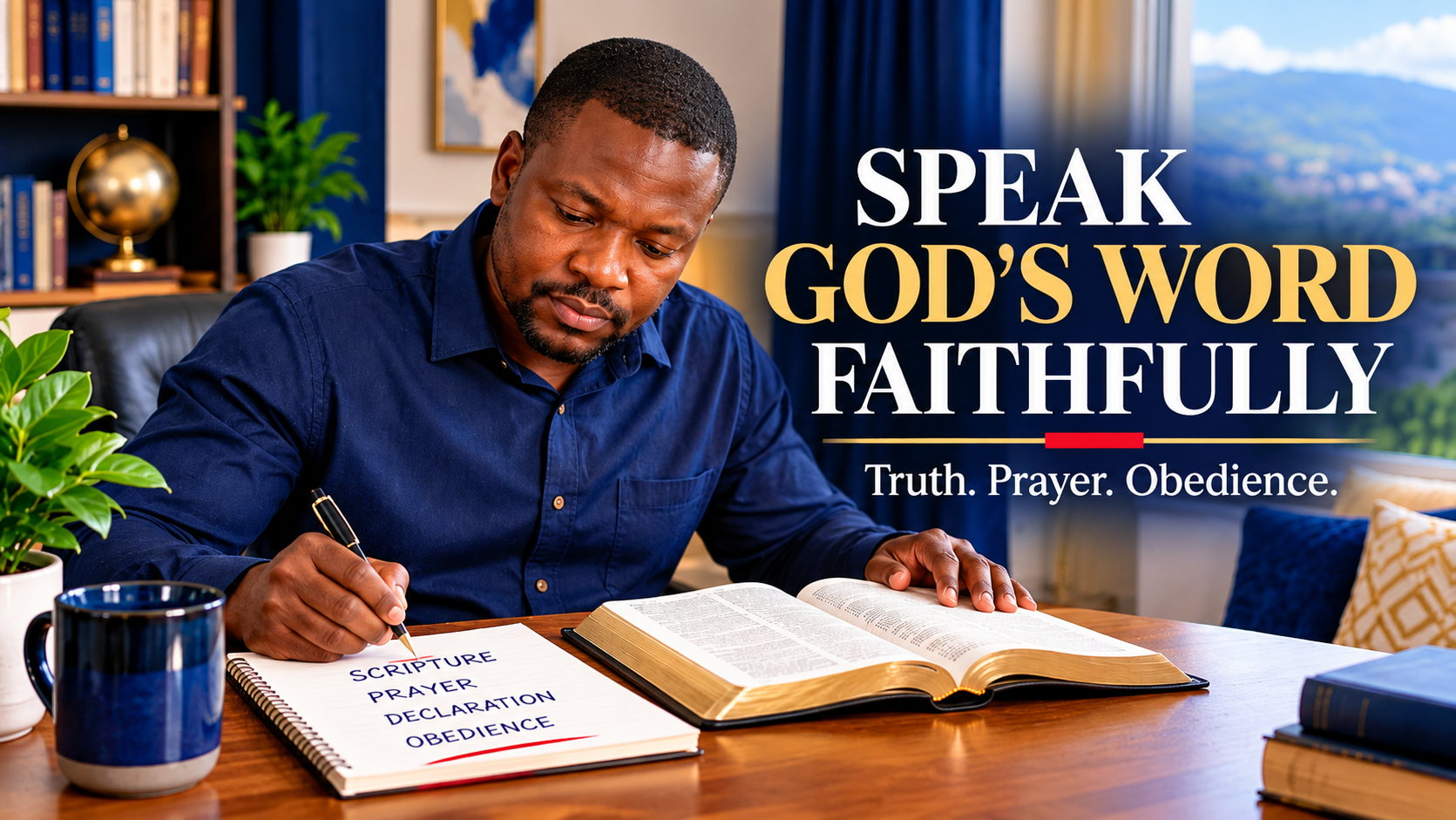
How to Speak God’s Word
Without Turning Faith Into a Formula
Learn how biblical truth can shape your speech,
prayers, decisions and daily responses without
reducing Christian faith to a verbal formula.
Scripture
Prayer
Biblical Declarations
Obedience
Written by Rev Elphas Sipho Mdluli
Speak God’s Word faithfully by allowing Scripture to shape what you believe, pray, declare and do. Biblical faith is not a formula for controlling circumstances. It is a Christ-centred response to God’s truth that brings together Scripture, prayer, trust, surrender and practical obedience.
Our words matter, but Christian faith involves far more than
positive speech. What we say must remain rooted in biblical
truth, centred on Jesus Christ and connected to obedient living.
There is an important difference between biblical faith and
treating words as a spiritual formula. Scripture does not teach
us to use words as a mechanism for forcing God to produce
whatever outcome we desire.
Biblical declarations are not magic words that force God to
give us whatever we want. Neither are they a method of
pretending that pain, sickness, financial difficulty,
disappointment or other challenges do not exist.
Rather, speaking God’s Word means bringing our thinking,
speech, prayers and responses under the authority of Scripture.
“Sanctify them by Your truth. Your word is truth.”
John 17:17 (NKJV)
1
Speak God’s Word Faithfully by Starting With Scripture
If we want to speak God’s Word faithfully,
Scripture must come before our declarations.
It can be tempting to begin with what we want and then search
for a Bible verse that appears to support it. A healthier
approach is to begin with Scripture itself.
Ask first: What does this passage actually teach?
Read the surrounding verses. Consider who was speaking,
who was being addressed and what the passage means within
the wider teaching of Scripture.
“Be diligent to present yourself approved to God,
a worker who does not need to be ashamed,
rightly dividing the word of truth.”
2 Timothy 2:15 (NKJV)
Before turning a verse into a declaration, seek to understand
it correctly. This protects us from using Scripture merely
to confirm our own desires.
2
Keep Jesus Christ at the Centre
Biblical faith is ultimately not faith in our ability
to speak correctly. It is faith in God.
The power of Christianity does not come from discovering
the perfect combination of words. Our confidence rests
in Jesus Christ—His finished work, His character,
His promises and His lordship.
“For all the promises of God in Him are Yes,
and in Him Amen, to the glory of God through us.”
2 Corinthians 1:20 (NKJV)
Christ should therefore remain at the centre of what
we believe and confess. Our words should direct our hearts
towards Him rather than merely towards the outcomes
we desire.
3
Faith Does Not Require You to Deny Reality
Faith does not require us to pretend. A Christian facing
difficulty can acknowledge the reality of the situation
while still trusting God.
David repeatedly demonstrated this in the Psalms.
He spoke openly about fear, opposition, discouragement
and danger. Yet he continually returned his attention
to the character and faithfulness of God.
“This situation is difficult, but God is with me.”
You may also acknowledge:
“I do not yet know how this problem will be resolved,
but I will seek God for wisdom and continue doing
what is right.”
Speaking biblical truth allows God’s truth to become
greater than fear without requiring us to deny reality.
4
Turn Scripture Into Prayer
One of the safest ways to develop biblical declarations
is to begin with prayer.
Suppose you are struggling with anxiety. Instead of
immediately making exaggerated statements about what
will happen, begin with Philippians 4:6–7 and bring
the matter before God.
Father, help me bring my concerns to You in prayer.
Guard my heart and mind through Christ Jesus.
From that prayer, a responsible declaration can emerge:
I will bring my anxieties to God in prayer and trust Him
to guard my heart and mind.
The declaration remains close to Scripture.
It does not attempt to control God. It expresses faith
while maintaining humility.
5
Connect Your Words With Obedience
Biblical declarations should influence behaviour.
What we confess from Scripture should increasingly
become visible in how we live.
“But be doers of the word, and not hearers only,
deceiving yourselves.”
James 1:22 (NKJV)
If you declare that God calls you to forgive,
begin taking steps towards forgiveness.
If you declare that God has called you to stewardship,
manage what He has entrusted to you responsibly.
If you declare that God gives wisdom,
seek wisdom before making important decisions.
The strongest declaration is often the one that becomes
visible through obedient living.
6
Avoid Turning Faith Into a Formula
There is a danger in believing that if we repeat certain
words enough times, God must produce the outcome we want.
That is not biblical faith.
God remains sovereign.
Prayer is relational, not mechanical.
“Nevertheless not My will, but Yours, be done.”
Luke 22:42 (NKJV)
This is not weak faith.
It is surrendered faith.
We can pray boldly. We can believe God’s promises.
We can speak Scripture confidently. Yet our confidence
must always remain under God’s authority.
7
Let God’s Word Renew Your Thinking
Speaking Scripture is especially valuable when it becomes
part of the renewal of the mind.
“And do not be conformed to this world,
but be transformed by the renewing of your mind…”
Romans 12:2 (NKJV)
Instead of allowing fear, disappointment or past experiences
to become the final authority, we allow God’s truth
to reshape our thinking.
This is where biblical declarations can become a valuable
spiritual discipline. They help us deliberately return
our minds to truth.
8
Make Your Declarations Christ-Centred and Responsible
A healthy biblical declaration should be something
you can genuinely say before God with humility.
Biblical Declarations for Faithful Christian Living
God is with me, so I will not allow fear
to control my decisions.
Through Christ, I will pursue forgiveness
rather than bitterness.
I will ask God for wisdom and act responsibly
with what He places in my hands.
My circumstances do not determine God’s character.
I will continue praying, obeying and trusting God
even while I wait.
These declarations do not attempt to manipulate circumstances.
They position the believer to respond to circumstances
through faith.
A Simple Pattern to Speak God’s Word Faithfully
Use this five-step framework to keep biblical declarations
rooted in Scripture, prayer and practical discipleship.
SCRIPTURE
What does God’s Word actually say?
TRUTH
What biblical truth should shape my thinking?
PRAYER
How should I bring this matter before God?
DECLARATION
What can I faithfully say in agreement
with Scripture?
OBEDIENCE
What faithful action should now follow?
Speak Life While Remaining Rooted in Truth
There is great value in learning to discipline our speech.
We do not need to allow fear, bitterness, hopelessness
or uncontrolled emotion to determine everything we say.
Speak God’s promises.
Declare biblical truth.
Pray confidently.
Reject destructive thinking.
Encourage yourself in the Lord.
But also remain humble, obedient and surrendered
to God’s will.
When we speak God’s Word faithfully,
our goal is not simply to say better words. We allow
biblical truth to shape our thinking, speech, decisions
and actions so that our lives increasingly reflect
Jesus Christ.
The goal is not simply to say better words.
The goal is to become a person whose thinking,
speech and actions increasingly reflect Jesus Christ.
Continue Growing Through Biblical Teaching
Freedom Centre International Church exists to help people
encounter biblical truth, grow in Christ and live out
their faith practically. Continue exploring our church
resources and ministry.
Father, thank You for giving us Your Word as truth.
Teach us to understand Scripture correctly and to allow
it to renew our minds. Guard us from using Your Word
carelessly or turning faith into a formula. Help us speak
with faith, humility and wisdom. May our prayers,
declarations, decisions and actions honour Jesus Christ.
Give us grace not only to hear Your Word but also to obey it.
In Jesus’ name, Amen.
Freedom Centre International Church • Biblical Teaching
How God’s Covenants Reveal His Faithfulness in Christ
Read God’s promises in their biblical setting, see their fulfilment in
Jesus and respond with faithful discipleship.
Written by Rev Elphas Sipho Mdluli
God’s covenants in Christ reveal that Christian hope rests on God’s
faithful character and redemptive work, not on treating every
biblical promise as an unrestricted personal guarantee.
God’s covenants in Christ help believers understand the
unity of Scripture and the faithfulness of God. From creation and the
calling of Abraham to Israel, David and the promised new covenant, God
steadily reveals His redemptive purpose. These covenant promises reach
their centre and fulfilment in Jesus Christ.
Christians sometimes read a comforting promise and immediately apply it
to every personal desire. Yet faithful Bible reading asks who received
the promise, what covenant setting shaped it and how the passage leads us
toward Christ. This approach does not weaken confidence. It grounds
confidence in what God has truly said and done.
What Is a Biblical Covenant?
A covenant is a solemn relationship established by God with defined
promises, responsibilities and purposes. Biblical covenants are not
casual agreements between equal parties. God graciously initiates them
and remains faithful to His revealed character.
The covenants unfold within the story of redemption. Each must be
understood in its own context, yet together they show that God does not
abandon His saving purpose when human beings fail.
God’s Covenants Reveal His Faithful Character
Noah’s story shows God preserving creation and promising that the regular
order of the earth would continue. Abraham received promises concerning
descendants, land and blessing. Through him, all the families of the
earth would be blessed.
Israel’s covenant at Sinai formed a redeemed people called to worship,
holiness and witness. The covenant with David promised a royal line and
directed hope toward a righteous King.
Jeremiah later announced a new covenant in which God would forgive sin
and write His law upon the heart. These promises display God’s patience,
justice, mercy and faithfulness.
God’s Covenants in Christ Find Their Centre in Jesus
The New Testament presents Jesus as the promised Son of David and the
mediator of the new covenant. At the Last Supper, He identified the cup
with the new covenant in His blood. His death was not an unfortunate
interruption. It was the sacrificial means through which forgiveness
and reconciliation would be secured.
Hebrews explains that Christ is the mediator of a better covenant.
Believers approach God through His finished work, not through personal
merit. Therefore, God’s covenants in Christ direct
attention away from human boasting and toward the sufficiency of Jesus.
Second Corinthians 1:20 declares that all God’s promises are “Yes” in
Christ. This does not mean every sentence becomes a guarantee of health,
wealth or ease. It means God’s saving promises and redemptive purposes
find their confirmation in His Son.
Read Every Promise in Its Covenant Context
Begin by identifying the original audience. Was the passage addressed to
Noah, Abraham, Israel, David, the exiles, the apostles or the church?
Then examine the conditions, historical situation and purpose of the
promise.
Next, ask how later Scripture develops the passage. Some promises were
fulfilled in a particular historical event. Others created expectations
that find fuller expression in Christ. Still others reveal enduring
truths about God’s character.
This prevents believers from claiming words that were never given as
individual guarantees. It also prevents disappointment created by
interpretations God did not promise to honour.
The New Covenant Brings Forgiveness and Inner Renewal
Jeremiah 31:31–34 promised a new covenant unlike the covenant Israel
broke. God would place His law within His people, forgive their iniquity
and remember their sin no more. Jesus established this covenant through
His blood.
Under the new covenant, believers receive forgiveness and the gift of
the Holy Spirit. Inner renewal does not produce instant perfection. It
begins a life of transformation in which God forms obedience from the
heart.
Understanding God’s covenants in Christ therefore gives
both assurance and responsibility. Grace welcomes us into fellowship
with God, and that same grace trains us to live as His people.
Covenant Grace Produces Faithful Discipleship
God’s faithfulness is not permission for careless living. The new
covenant creates a people who belong to Christ. Believers are called to
love God, love one another, pursue holiness, practise justice and bear
faithful witness.
Obedience does not purchase covenant grace. It is the grateful response
of people who have received mercy. When Christians fail, they do not
hide behind religious performance. They confess sin, receive cleansing
through Christ and return to faithful practice.
Avoid Turning Covenant Into Prosperity Language
Covenant teaching becomes distorted when it is reduced to material
entitlement. Scripture never presents God as a mechanism for obtaining
luxury, status or immunity from suffering. Jesus promised His disciples
both His presence and real opposition.
The greatest covenant blessings are reconciliation with God,
forgiveness, the Holy Spirit, adoption into God’s family and the hope of
resurrection. Material provision should be received with gratitude,
stewarded responsibly and never treated as the measure of faith.
How God’s Covenants in Christ Strengthen Prayer
Prayer becomes more stable when it rests on God’s character. We can ask
for daily provision, wisdom, healing and intervention while still
submitting our requests to His will. Confidence is not controlling the
outcome. It is trusting the Father revealed through Christ.
Pray Scripture in context. Thank God for promises truly given to
believers. Ask the Holy Spirit to form covenant faithfulness within you.
When circumstances remain difficult, remember that God’s final purpose
is larger than immediate comfort.
Live as a Covenant Community
The new covenant does not create isolated believers. Christ forms a
people. The church gathers around the Word, prayer, fellowship, baptism
and the Lord’s Supper. These practices remind believers that faith
belongs within a shared life of worship and accountability.
A covenant community learns to keep its word, forgive, serve, protect
the vulnerable and restore those who repent. Such faithfulness becomes
a visible witness to the God whose character the church proclaims.
Practical Steps for Studying God’s Covenants in Christ
First, read the main covenant passages in their wider chapters. Study
Genesis 9, Genesis 12 and 15, Exodus 19–24, 2 Samuel 7, Jeremiah 31,
Luke 22 and Hebrews 8–10.
Second, write down what God promises, what He requires and how the New
Testament develops the covenant theme.
Third, keep Jesus at the centre. Ask how His life, death, resurrection
and present reign fulfil God’s redemptive purpose.
Finally, turn understanding into obedience. Thank God for His
faithfulness. Confess where you have been unfaithful. Honour your
commitments, participate in Christian fellowship and live as someone
who belongs to Christ.
Trust the Faithful God Revealed in Christ
God’s covenants in Christ show that the Bible tells one
unfolding story of creation, promise, redemption and restoration. God
acts faithfully even when human failure is severe. His promises reach
their saving centre in Jesus.
Read each covenant in context. Refuse careless claims and prosperity
distortions. Receive the forgiveness and new life secured through
Christ. Then respond with worship, obedience and faithful participation
in His church.
Our hope is not that we can force every desired outcome. Our hope is that
the God who has revealed Himself in Christ remains faithful.
Recommended Christian Resource
Everlasting Promises: Understanding Godly Covenants and How They
Shape Your Life Today
by Elphas Sipho Mdluli is a catalogue-verified resource for readers
studying biblical covenants, God’s faithfulness and their significance
in Christ.
No price, format, review, ranking or sales result is claimed.
Continue in Biblical Fellowship
Study these passages prayerfully, discuss them with mature believers
and remain connected to a faithful local church. Explore FCIC’s
discipleship pathway for further biblical formation.
Freedom Centre International Church • Biblical Teaching
Biblical Dominion Under Christ: Not Control Without Him
Understand spiritual authority as submission, stewardship and faithful
service under the lordship of Jesus.
Written by Rev Elphas Sipho Mdluli
Biblical dominion under Christ means exercising delegated
responsibility in submission to Jesus, Scripture and accountable
Christian community. It is stewardship and service, not control over
people or a promise of unrestricted power.
Introduction to Biblical Dominion Under Christ
Biblical dominion under Christ is not a licence for
pride, control or spiritual performance. It is the responsible exercise
of God-given stewardship under the authority of Jesus. Christians are
called to serve, cultivate, protect and represent God’s character.
Therefore, dominion must begin with submission. If our understanding of
authority makes us less humble, less accountable or less obedient, we
have misunderstood it.
The language of dominion can inspire faith, but it can also be misused.
Some people hear it and imagine personal power without limits. Others
avoid the subject because they have seen authority used to manipulate
people or promise spectacular results. Scripture offers a better path.
It presents authority as delegated, accountable and directed towards
God’s purposes.
This article explores how believers can understand
biblical dominion under Christ without confusing it
with control. It also offers practical steps for exercising spiritual
authority through prayer, wise action, faithful stewardship and service.
Biblical Dominion Under Christ Begins With God’s Ownership
Genesis 1:26–28 records God giving humanity responsibility within
creation. Yet this responsibility never transferred ownership away from
God. Psalm 24:1 declares that the earth and everything in it belong to
the Lord. Human authority is therefore stewardship, not possession
without accountability.
A steward manages something that belongs to another. The steward’s
freedom is real, but it is not absolute. Decisions must reflect the
owner’s character and purpose. In the same way, believers do not exercise
authority to build private kingdoms. We serve within God’s kingdom and
remain answerable to Him.
This truth corrects both passivity and pride. Passivity refuses
responsibility. Pride acts as though responsibility has no boundaries.
Biblical stewardship rejects both errors. It receives an assignment from
God and fulfils it with humility, diligence and care.
Christ Defines the Meaning of Biblical Authority
Jesus is not merely an example added to a general theory of dominion. He
is the centre of Christian authority. Colossians 1:16–17 teaches that
creation exists through Him and for Him. After His resurrection, Jesus
declared that all authority in heaven and on earth had been given to Him
in Matthew 28:18. Every Christian claim to authority must therefore
remain under His lordship.
Jesus also showed what authority looks like. He healed, delivered, taught
truth, confronted hypocrisy and protected the vulnerable. Yet He rejected
self-exaltation. He washed His disciples’ feet and taught that greatness
is expressed through service. Christian authority cannot be separated
from the character of Christ.
When power becomes more important than love, accuracy or accountability,
it has moved away from Jesus.
Biblical dominion under Christ should make a believer
more responsible, not more impressive. It should deepen obedience, not
create spiritual entitlement.
Biblical Dominion Under Christ Is Delegated Authority
Delegated authority operates within the will of the one who gives it. A
representative cannot responsibly use another person’s name for purposes
that person has not authorised. Likewise, Christians should not attach
God’s authority to personal impulses, untested impressions or exaggerated
promises.
Luke 10:19 records Jesus giving His disciples authority in the context of
mission. Their authority served the work He assigned. Later, when they
rejoiced over spiritual results, Jesus redirected their joy towards
their relationship with God in Luke 10:20. The lesson is important:
spiritual effectiveness must never become the foundation of identity.
Authority should be tested by Scripture, exercised in prayer and kept
accountable within Christian community. Mature believers remain
teachable. They are willing to examine motives, receive correction and
admit when they do not know.
Dominion Is Not the Same as Controlling People
God does not authorise believers to dominate another person’s
conscience, choices or dignity. Spiritual leadership may teach, warn,
guide and correct, but it must not manipulate. Fear, secrecy, humiliation
and dependency are not evidence of godly authority.
A pastor cannot replace the Holy Spirit in a believer’s life. A spouse
cannot use spiritual language to silence the other spouse. A leader
cannot claim divine authority to avoid questions or accountability.
Healthy Christian leadership points people towards Christ, Scripture,
mature discernment and responsible decisions.
This distinction protects both leaders and those they serve. It
encourages clear boundaries. It also reminds every believer that
influence should help others grow in truth and maturity rather than
become dependent on a personality.
Exercise Biblical Dominion Through Prayer and Obedience
Prayer is central to
biblical dominion under Christ because prayer
acknowledges dependence on God. It is not a technique for forcing
outcomes. It is fellowship, petition, listening, surrender and spiritual
resistance shaped by God’s Word.
Prayer should lead to obedience. If a person prays for financial
stability, wise dominion may include budgeting, reducing unnecessary
costs and seeking sound advice. If a family prays for peace, obedience
may include honest conversation, forgiveness and new boundaries. If a
church prays for community transformation, it may also need to serve,
teach, visit and organise responsibly.
Faith does not remove practical responsibility. Instead, faith gives
practical responsibility a God-centred direction. Prayer and wise action
belong together.
Steward Your Assigned Sphere Faithfully
Most expressions of dominion are ordinary. They appear in how we manage
time, speech, work, relationships, resources and opportunities. A
believer exercises stewardship by bringing order where there is
confusion, care where there is neglect and truth where there is
deception.
You do not need to control everything around you. Begin with what God has
actually entrusted to you. That may be a household, a classroom, a
ministry responsibility, a business assignment or a personal habit. Ask
what faithfulness looks like in that sphere today.
Biblical dominion under Christ grows through consistent
obedience. Dramatic language cannot substitute for dependable character.
Small acts of integrity, preparation and service often reveal spiritual
maturity more clearly than public displays.
Test Spiritual Claims Carefully
Claims about spiritual laws, authority and supernatural outcomes require
biblical discernment. Scripture instructs believers to test what they
hear and hold fast to what is good in 1 Thessalonians 5:21. Testing is
not unbelief. It is part of faithful discipleship.
Ask whether a teaching honours Jesus, agrees with Scripture, produces
godly character and allows responsible accountability. Be cautious when
someone promises guaranteed material outcomes, treats every hardship as
evidence of spiritual failure or presents personal revelation as
unquestionable.
We must also distinguish pastoral teaching from medical, legal or
financial advice. Prayer and biblical encouragement are valuable, but
specialised problems may require qualified professional assistance.
Responsible faith does not fabricate expertise.
A Practical Framework for Biblical Dominion Under Christ
The following five questions can guide daily practice.
First, submission: Have I placed this decision under the
lordship of Jesus?
Second, Scripture: Does my intended action agree with
God’s revealed character and commands?
Third, stewardship: What responsibility has actually
been entrusted to me?
Fourth, service: Will this action protect, strengthen
or responsibly serve others?
Fifth, accountability: Am I willing for mature believers
to examine my motives and methods?
Use these questions before making declarations, confronting a problem or
claiming spiritual direction. They slow down impulsive reactions and
help authority remain connected to wisdom and love.
How Biblical Dominion Under Christ Changes Everyday Life
In the home, it produces responsibility rather than control. Family
members pray together, listen carefully, forgive and make practical
commitments. At work, it produces diligence, honesty and wise
problem-solving. In ministry, it produces service, doctrinal care and
protection of people. In personal growth, it produces disciplined habits
and renewed thinking.
This approach does not promise that every outcome will change
immediately. Christians still face opposition, uncertainty, suffering
and human limitation. Dominion is not a denial of reality. It is a
faithful response to reality under God’s authority.
Sometimes the faithful response is to act. Sometimes it is to wait, seek
counsel or accept a boundary. Spiritual maturity includes knowing the
difference.
Conclusion: Live Under the Authority of Jesus
Biblical dominion under Christ is received through
relationship with Jesus and exercised through faithful stewardship. It
does not make believers independent from God. It draws them into deeper
submission, clearer responsibility and more Christlike service.
Begin where you are. Place your assignment before God. Examine your
motives. Act within the authority and responsibility He has actually
given you. Refuse manipulation, exaggeration and careless promises. Then
serve faithfully, pray persistently and remain accountable.
The strongest evidence of spiritual authority is not spectacle. It is a
life that increasingly reflects the truth, humility, courage and love of
Jesus Christ.
Recommended Christian Resource
Spiritual Dominion and the Governance of Creation
by Elphas Sipho Mdluli explores biblical laws, spiritual intelligence
and kingdom responsibility. It supports readers who want to study
spiritual authority while preserving submission, stewardship and
accountability.
Use this teaching as a starting point for prayer, Bible study and
accountable discipleship. Explore the FCIC discipleship pathway and
remain connected to a faithful Christian community.
How to Build Spiritual Unity in Marriage Through Shared Faith Practices
Build a shared spiritual direction through prayer, Scripture, forgiveness,
wise decisions and faithful Christian community.
Written by Rev Elphas Sipho Mdluli
Spiritual unity in marriage grows as a couple seeks God together and
practises shared prayer, Scripture, forgiveness, wise stewardship and
faithful obedience.
Spiritual unity in marriage grows when a husband and wife learn to seek God
together and allow their faith to shape ordinary decisions. It does not mean
that two people have identical personalities, prayer styles or levels of
spiritual maturity. It means they are choosing a shared direction under
Christ, with Scripture, prayer, forgiveness and faithful obedience becoming
part of the life they build together.
Many Christian couples sincerely love God but practise faith mostly as
individuals. One spouse prays alone. Each person reads Scripture separately.
Difficult decisions are discussed without prayer, and spiritual concerns are
mentioned only during a crisis. Personal devotion remains valuable, but
marriage also needs shared practices that strengthen trust and help the
couple recognise that they belong to God together.
Shared faith practices should not become a measure of superiority or a
method of controlling a spouse. They are simple rhythms through which a
couple makes room for God, listens to one another and responds faithfully.
The goal is not performance. The goal is a marriage increasingly shaped by
the character and teaching of Christ.
What Spiritual Unity in Marriage Means
Spiritual unity in marriage is a shared commitment to honour Christ in the
relationship. It includes agreement about the direction of the home,
willingness to pray and learn together, and mutual responsibility for living
out biblical values.
Unity is not uniformity. One spouse may speak freely in prayer while the
other is quieter. One may understand Scripture quickly while the other needs
more time and discussion. A healthy marriage does not force both people into
one personality. It helps them move in one spiritual direction while
respecting how each person grows.
Ecclesiastes 4:9–10 teaches that two are better than one because each can
help the other when one falls. In marriage, that partnership includes
spiritual encouragement. A spouse can remind the other of God’s faithfulness,
offer prayer during pressure and help turn biblical conviction into
practical action.
Begin Spiritual Unity in Marriage With Honest Conversation
Couples cannot build spiritual unity through assumptions. Begin with a calm
conversation about the present condition of your shared faith life. Ask what
helps each person feel spiritually supported. Discuss what has become
difficult and what kind of practice would be realistic in the current
season.
Avoid using the conversation to accuse. Statements such as “You never pray
with me” usually create defensiveness. A more constructive approach is:
“I would like us to make more room for prayer together. What would feel
natural and sustainable for both of us?”
Honesty may reveal different expectations. One spouse may imagine a long
daily devotion while the other can manage ten focused minutes several times
a week. The couple can begin with a small practice they can keep, then review
it later.
Pray Together in a Simple and Sustainable Way
Shared prayer is one of the clearest practices for spiritual unity in
marriage. Prayer allows couples to bring gratitude, needs, decisions and
concerns before God together. It also helps each spouse hear what matters
deeply to the other.
Begin simply. Pray for a few minutes before sleep, after breakfast or before
an important decision. Each person can mention one point of gratitude and
one request. A short sincere prayer practised consistently can be more
helpful than an ambitious routine that quickly disappears.
Do not use prayer to correct your spouse indirectly. Prayer should not become
a sermon in which one person tells God everything the other person is doing
wrong. If a concern needs discussion, speak about it honestly and
respectfully outside the prayer.
Read and Apply Scripture as a Couple
A shared Bible practice gives a couple common language for decisions and
growth. This does not require completing a large reading programme. Choose a
short passage, read it carefully and discuss one question: What should this
truth change in the way we live?
James 1:22 warns believers to be doers of the word and not hearers only.
Therefore, shared reading should lead toward application. A passage about
patience may affect how the couple handles disagreement. Teaching about
stewardship may lead to a budget conversation. A command to forgive may
reveal where repair is needed.
When interpretations differ, remain teachable. Read the context, consult
responsible biblical teaching and avoid turning every disagreement into a
test of loyalty. Scripture should bring the marriage under God’s authority,
not provide ammunition for one spouse to dominate the other.
Strengthen Spiritual Unity Through Forgiveness
Unresolved hurt weakens spiritual unity in marriage because a couple cannot
easily pray, listen and serve together while resentment is being protected.
Forgiveness does not deny harm or remove the need for accountability. It
refuses to make revenge, contempt or permanent condemnation the governing
response.
Ephesians 4:32 calls believers to be kind, tenderhearted and forgiving. In
marriage, this includes naming wrong clearly, apologising without
blame-shifting and making change visible. Reconciliation may require more
than one conversation, especially where trust has been damaged.
Serious harm, abuse, coercion or danger should not be hidden under language
about submission or forgiveness. Appropriate pastoral, safeguarding, legal
or professional support may be necessary. General biblical encouragement
does not replace specialised help.
Make Decisions With Shared Faith and Practical Wisdom
Spiritual unity becomes visible when faith shapes decisions about money,
family, work, church involvement and the use of time. Before a major
decision, agree on the facts, pray for wisdom, consider biblical principles
and discuss the likely consequences.
James 1:5 encourages believers who lack wisdom to ask God. Asking should
work alongside responsible enquiry. A couple considering a financial
commitment should pray and examine the numbers. A family decision may
require counsel and careful planning. Faithful stewardship does not require
ignoring evidence.
If agreement does not come immediately, avoid forcing a quick answer merely
to end discomfort. Identify what information is missing, what can wait and
when the discussion will resume. Patient discernment can protect both the
relationship and the decision.
Worship and Serve Together Without Performing
Corporate worship and Christian fellowship can strengthen spiritual unity in
marriage. Attend church together where possible, participate in discipleship
and build relationships with mature believers. Community helps a couple
receive teaching, encouragement and accountability beyond their own
perspective.
Serving together can also unite a couple around a purpose larger than
personal comfort. Service may include hospitality, practical care, ministry
support or helping someone in need. The activity should fit the couple’s
season and capacity.
Do not compare your marriage with couples who appear more visible in
ministry. Public activity does not automatically prove private health.
Choose forms of worship and service that are sincere, responsible and
consistent with the care your marriage and family require.
Respect Different Seasons of Spiritual Growth
At times, one spouse may feel spiritually strong while the other is tired,
discouraged or uncertain. Spiritual unity in marriage does not require
pretending that both people are always in the same place. It requires
patience and a refusal to shame the person who is struggling.
Encourage without controlling. Offer prayer, listen carefully and invite
participation without turning every quiet season into a crisis. At the same
time, do not ignore persistent withdrawal, destructive behaviour or
rejection of responsibilities that materially harms the marriage.
A mature couple learns when to wait, when to speak, when to seek counsel and
when to establish necessary boundaries. Love combines grace with truth.
A Weekly Shared Faith Rhythm
A simple weekly rhythm can help couples practise spiritual unity in marriage
without creating an unrealistic programme.
Choose one short Scripture passage to read and discuss.
Share one reason for gratitude and one concern requiring prayer.
Review one practical area such as money, family responsibilities or time.
Ask whether any apology, forgiveness or clarification is needed.
Agree on one faithful action and one time to follow up.
The rhythm can take fifteen to thirty minutes. Keep it relational rather
than mechanical. Some weeks will need deeper conversation. Other weeks may
involve only prayer and one practical decision. Consistency matters more
than creating an impressive routine.
When You Are Starting From Different Places
Some couples begin marriage with different levels of biblical knowledge or
church involvement. Others experience change later. One spouse may grow more
interested in faith while the other becomes hesitant. Pressure rarely
produces genuine spiritual maturity.
Begin with respect, prayer and honest conversation. Invite rather than
manipulate. Live your faith with humility. Where appropriate, seek pastoral
guidance that honours both truth and the dignity of each person.
If the difference affects major commitments, child-rearing, financial
stewardship or the safety of the relationship, do not pretend that the issue
is small. Address it carefully before resentment becomes established.
Build Spiritual Unity in Marriage One Practice at a Time
Spiritual unity in marriage usually grows through ordinary practices
repeated with sincerity. Pray together. Read and apply Scripture. Repair
hurt. Make decisions under God’s wisdom. Worship, serve and remain connected
to faithful Christian community.
Begin with one practice that fits your present season. Keep it simple enough
to sustain and meaningful enough to shape the relationship. Review what is
helping, and adjust without turning the practice into another source of
conflict.
A spiritually united marriage is not a marriage without differences or
difficulties. It is a marriage in which two people keep bringing their
shared life under Christ and learning to walk faithfully together.
Optional Supporting Christian Marriage Resource
Building a Sacred Union: Biblical Guidance for Unbreakable Marriage
Bonds
by Elphas Sipho Mdluli is a catalogue-verified resource for couples
seeking biblical guidance on unity, resilience and purpose in marriage.
It is offered as optional further reading and does not replace Scripture,
pastoral care, safeguarding or appropriate professional support.